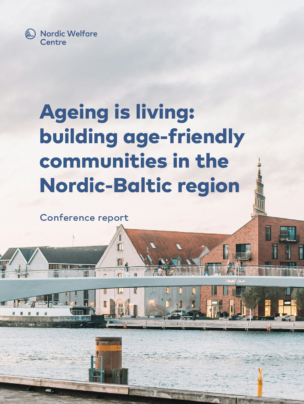
The conference Ageing is Living: Building Age-Friendly Communities in the Nordic-Baltic Region was held in Copenhagen on 25–26 November 2025. It was organised by the Nordic Welfare Centre in collaboration with the WHO Regional Office for Europe and the Centre for an Age-Friendly Norway.
The event brought together policymakers, researchers, urban planners and practitioners from across the Nordic and Baltic region to share knowledge and practical examples of how communities can support diversity, inclusion and social cohesion across all ages. A central concept throughout the conference was age-friendly communities, as defined by the World Health Organization.
An age-friendly city or community is designed to promote healthy and active ageing by reducing physical and social barriers, enabling people to maintain their functional abilities and quality of life as they age. These efforts are closely linked to the UN Decade of Healthy Ageing (2021–2030). Since 2017, the Nordic Welfare Centre has coordinated a Nordic network for age-friendly cities and communities, which currently includes 26 cities across the Nordic region, all of which are also members of the WHO Global Network for Age-Friendly Cities and Communities. Within the Nordic network, the members exchange everything from knowledge and inspiration to practical solutions that work in a Nordic context.
The conference focused on four central themes: strengthening social connections and reducing loneliness, building age-friendly environments through urban planning, promoting co-creation in age-friendly communities, and assessing the impact of age-friendly initiatives.
The report summarises the main ideas from the presentations at the conference and aims to highlight both emerging research and concrete examples of practice from across the Nordic-Baltic region.