Danish minister Mette Kierkgaard: “We have to make age-friendly societies a public movement”
Eldre Voksne
10 des 2025
Danish Minister of Senior Citizens, Mette Kierkgaard, envisions age-friendly communities as a movement where politicians, architects, health care professionals and civil society work together. At the Ageing is Living conference in Copenhagen, discussions focused on how communities in the Nordic-Baltic region can become more inclusive for older adults as populations age worldwide – and why young people must also be engaged.
– Age-friendly communities are everyone’s business; no single actor can do it alone. Even though WHO has many priorities, including climate change, age-friendly living is one of the organization’s top five priorities, says Natasha Azzopardi-Muscat, Director of the Division of Health Systems at the WHO Regional Office for Europe.
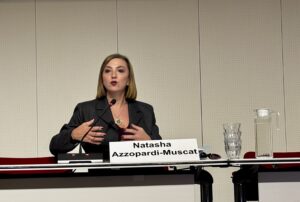
– Today, many countries look to the Nordic region for inspiration.
On 25–26 November, the conference Ageing is Living: Building Age-Friendly Communities in the Nordic-Baltic Region brought together around 180 participants from approximately ten countries in Copenhagen. The conference, organized by the Nordic Welfare Centre in collaboration with the WHO Regional Office for Europe and the Centre for an Age-Friendly Norway, shared insights and best practices for developing and supporting age-friendly communities in the Nordic-Baltic region. Attendance had tripeled since the last conference two years ago, highlighting the growing interest in the topic.
An age-friendly environment is a place where getting older is a good thing. It is an environment with no physical and social barriers, one that promotes a healthy and happy life in which it is possible to maintain life-long physical and mental capacity, and where older adults are seen as a resource.
Senior citizens not a homogeneous group
A clear, common message from the conference speakers was that senior citizens are not a homogeneous group, and should be treated accordingly.
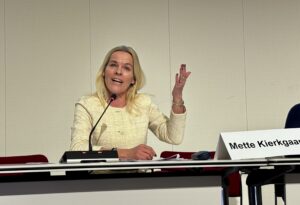
– Older adults receiving care are just as diverse as the rest of us, which is why we need flexibility in the care system. Our (Denmark’s) legislation up until now has emphasized centralization, documentation, and rigid schedules, promoting a malfunctioning elderly care system, says Danish Minister of Senior Citizens, Mette Kierkgaard.
Instead, we need self-determination for older people, trust in employees and managers and their competencies, and collaboration between professionals and civil society, she says, something that Denmark has now implemented in a new Elder Care Law, adopted in July.
– Now we are working together on ideas for an age-friendly society from a bottom-up perspective, including architects and civil society. It is important that age-friendly societies don’t become something only for governments or councils; we have to make age-friendly societies a public movement.
Intergenerational solidarity is key
2019 marked a shift in demography: for the first time, there were more people over 65 than children under 5 globally. Creating age-friendly communities requires solidarity across generations, including young people.
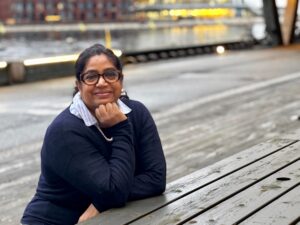
– Age-friendly societies improve life not only for older people but also for younger generations, says Chitralekha Marie Massey, Chief of the Rights of Older Persons Section at the United Nations Office of the High Commissioner for Human Rights.
– As we take on this task, we must ensure that younger people are actively involved and see it as an investment in their own future. If you make a city a safe and thriving space for an 8-year-old and an 80-year-old, everyone in between benefits automatically, she adds.
There are many synergies between building age-friendly cities and creating sustainable or human-rights–friendly cities. At its core, these initiatives share the same goal: ensuring effective enjoyment of fundamental human rights such as access to housing, transportation, public spaces, healthcare, information, employment, and equal opportunities.
– Rights are interdependent. If you address one right, you create positive ripple effects across many others, says Massey.
Historic shift towards age-friendly global society
In April, a historic milestone was reached. Eighty-six UN Member States in the Human Rights Council agreed on the need for an international, legally binding UN convention on the rights of older persons.
– This is a call to action. It has taken the UN twenty years of discussion to agree on this framework. I see the new legally binding instrument as a wonderful opportunity for all of us, everywhere, to rewire our systems to ensure dignity to all persons at every age, specifically for the Nordic region – which has been a leader on issues such as gender equality – to exhibit leadership, says Massey.
To make sure that the legislation do not remain just words on paper, we need better data on the lives of older adults. As long as older adults remain invisible in our statistics, it becomes an excuse not to act, she says.
– What we cannot count or measure, we do not act on. That is why improving data collection is key to making real change.
Text & photo: Heidi Hakala
Facts:
- The conference Ageing is Living had four main themes: Strengthening Social Connection and Reducing Loneliness, Building Age-Friendly Environments through Urban Planning, Co-creation in Age-friendly Communities, and The Impact of Age-friendly Communities.
- The WHO has identified eight interrelated areas with which an age-friendly city or community should work. These are community and health care, transportation, housing, social participation, outdoor space and buildings, respect and social inclusion, civic participation and employment, and communication and information.
- In June 2026, the global World Congress for Age-friendly Cities and Communities will be held in Spain. The meeting will bring together representatives from around the world to share best practices, public policies, and experiences in building more inclusive environments for older people, with a focus on creating networks and strengthening resilience among older populations in response to pandemics, climate change, and conflicts.
Sources: WHO & the Nordic Welfare Centre


