Age-friendly development requires a whole-of-society approach
Iäkkäät
1 heinä 2026
The Nordic region, home to almost 28 million people, spans from dense urban centres to rural and Arctic areas. Since Oslo became the first Nordic city to join the WHO Global Network for Age-friendly Cities and Communities in 2014, the Nordic network for age-friendly cities and communities has supported collaboration and knowledge exchange across the region. Established on a mandate from the Nordic Council of Ministers, the network contributes to the Nordic Vision 2030 by supporting age-friendly development at the local level.
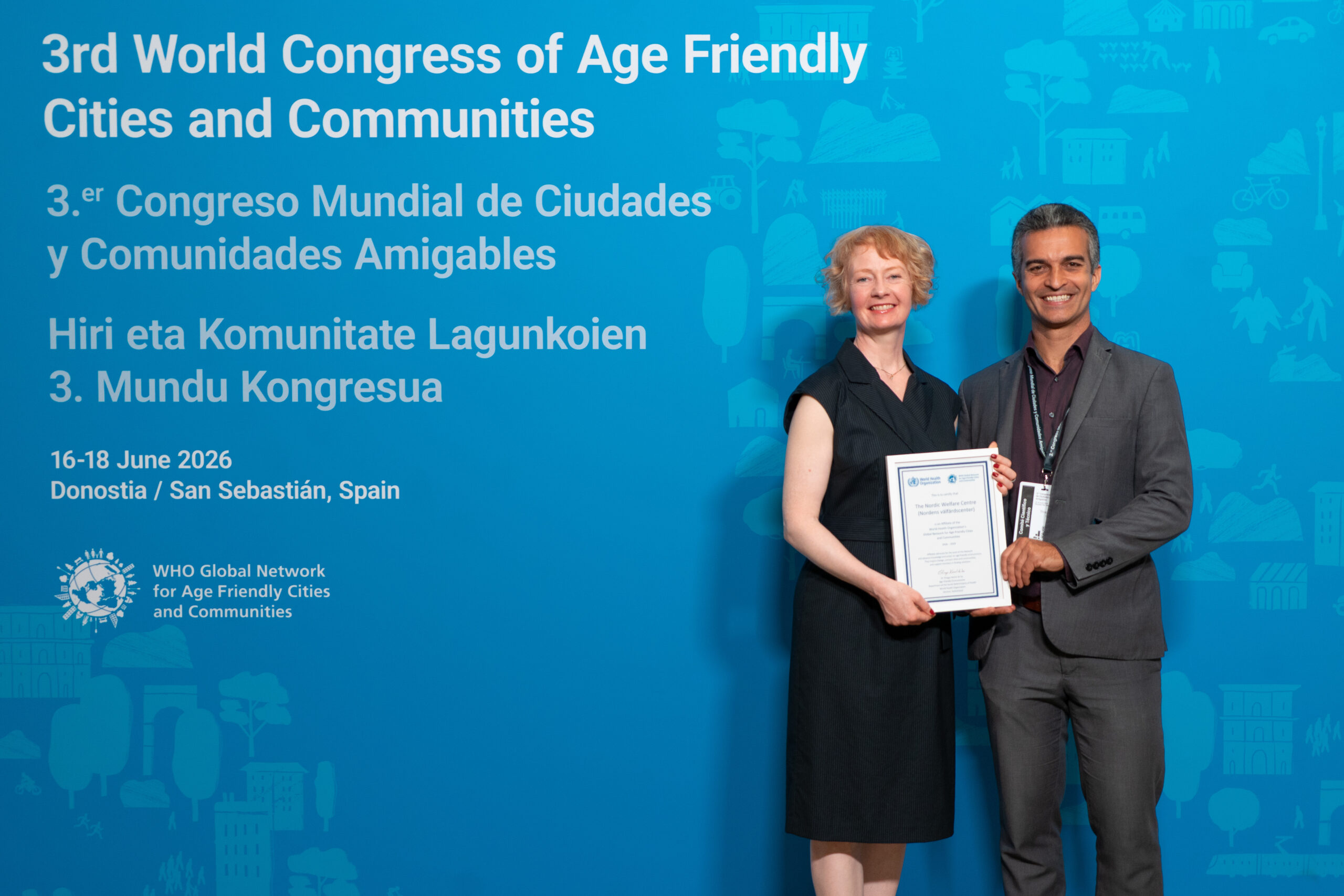
At the 3rd World Congress for Age-friendly Cities and Communities in Spain in June 2026, the Nordic network for age-friendly cities and communities and the Nordic Welfare Centre became affiliate partners of the WHO Global Network for Age-friendly Cities and Communities. The affiliation strengthens the Nordic Welfare Centre’s role as a regional knowledge hub and expands opportunities for international knowledge exchange.
To guide the future work of strengthening age-friendly development in the Nordic and Baltic region, 5 experts were invited to provide perspectives on current developments and challenges in the regions, with a focus on the built environment, national coordination and age-friendly development as a broad societal movement across sectors.
Creating places where people can age well
In recent years the awareness of the importance of age-friendly environements has grown significantly. Municipalities are increasingly considering accessibility, mobility, housing and social participation when planning communities for ageing populations. At the same time, several challenges remain.
According to Antti Rehunen, Senior research scientist at the Finnish Environment Institute (SYKE), many cities have made progress in areas such as accessibility and walkability, but at the same time inequality is growing within urban areas. As services become more concentrated, some older adults face barriers related to transport, housing, and access to everyday services.
According to research at SYKE, GIS-based data uses digital mapping tools to combine information on population, housing, transport and local services. This helps municipalities identify local needs, predict where ageing populations will grow, and plan infrastructure more effectively. It also allows age-friendly development to be analysed alongside factors such as housing, green spaces and transport.
“GIS-based data helps predict where ageing populations will grow and what kind of infrastructure will be needed.”
– Antti Rehunen, Senior research scientist at the Finnish Environment Institute (SYKE)
The built environment also plays an important role in supporting social life. In Võru, Estonia, age-friendly development has taken the form of a new cross-generational community center. Tiina Hallimäe, development manager at the town government, describes the center as a welcoming meeting place where people of different ages can connect, participate, and build a sense of belonging. At Võru, they see great value in the synergy that emerges when different generations and organizations share the same space. It allows the municipality to make the best use of their resources and increase the multifunctional use of the building.
While local innovation is crucial in advancing age-friendly development in municipalities such as Võru, a national framework is required to provide the conditions for long-term and coordinated development. As Antti Rehunen points out from a Finnish perspective, while age-friendly development advances in important areas, it is still often driven by individual projects rather than long-term strategies. Most cities lack both cross-sectoral programmes and strategic long-term commitment.
National frameworks set direction and promote long-term commitment
From Sweden, Margareta Eriksson, Ombudsman for older adults in Stockholm, similarly explains that many municipalities are already working actively with age-friendly development, but that efforts are often dependent on local priorities and individual champions. From a municipal perspective, a national framework can provide legitimacy and continuity.
The Centre for an age-friendly Norway has held the role of national coordination and resource hub since 2021. From this work, Nina Myklebust, Director, Centre for an Age-friendly Norway highlights the importance of setting clear parameters from what can be expected from state and municipalities as well as from older citizens themselves.
“Political leadership must speak openly about both the challenges and the opportunities ahead, thereby creating ownership among organizations and citizens alike.”
– Nina Myklebust Director, Centre for an Age-friendly Norway
Age-friendly work often remains sector-based because financial structures and organisational models reinforce silo thinking, Nina Myklebust furthermore points out.
According to Aske Juul Lassen, Associate professor at the University of Copenhagen, national frameworks should also help change the way societies think about ageing. As a member of the National Council for an age-friendly Denmark, he sees an opportunity to move beyond traditional perceptions of older age and highlight the contributions that older adults make to society.
“The next important step is to see the ageing of societies as a capacity reform and not a burden.”
– Aske Juul Lassen, Associate professor at the University of Copenhagen
Aske Juul Lassen furthermore emphasizes that the experience and wisdom of older adults are crucial to the survival of Nordic democracies. As Nina Myklebust also points out, societies need to move away from seeing ageing primarily as a health and care issue and instead recognize the diversity, resources and contributions of older people. If communities are to respond successfully to demographic change, age-friendly thinking must become part of how societies are planned, governed, and developed across sectors.
Age-friendly development is a shared societal responsibility
Drawing on Stockholm’s work with age-friendly development, Margareta Eriksson highlights that age-friendly development becomes a broader agenda when ageing is understood as a societal issue that influences housing, mobility, public spaces, digital inclusion, climate adaptation, culture and participation.
“When age-friendly work is placed solely within health and social care structures, it tends to remain sector-based.”
–Margareta Eriksson, Ombudsman for older adults in Stockholm
In Stockholm, a city-wide action plan has helped create shared ownership across departments and municipal companies by linking age-friendly goals to existing priorities such as sustainability, accessibility, and public health. The process itself has been important, as the action plan has been used not only as a policy document but also as a tool for organisational change and dialogue. The collaborative process of revising the plan created opportunities to discuss how different sectors contribute to age-friendliness and where stronger coordination is needed.
Another practical example of age-friendly development across sectors can be found at the intergenerational activity center in Võru. The municipality involved residents, organisations and professionals from different sectors throughout the process, which has strengthened both the concept and local ownership.
Tina Hallimäe also highlights the value of learning from other municipalities across the Nordic and Baltic region. As a small municipality in a socio-economically less advantaged region of Estonia, Võru cannot implement large-scale developments all at once. With a grant from the Nordic-Baltic mobility programme for public administration, Võru was able to send a delegation to other municipalities in Norway and Sweden.
“When you see solutions working elsewhere, you begin to believe that positive change is possible in your own community as well.”
– Tiina Hallimäe, Development manager at Võru town government
Study visits are not about copying solutions, Tiina adds. They are about learning, saving time and resources, and making better informed decisions. Nordic and Baltic municipalities share similar demographic challenges, so there is much to learn from each other while still adapting solutions to local contexts.
Together, these experiences show that age-friendly development is most effective when it becomes a shared societal project, involving actors across sectors, levels of government, and civil society. Age-friendly development requires long-term commitment, collaboration across sectors and levels of government, and meaningful involvement of older people themselves.
Towards more age-friendly and inclusive communities
As demographic change continues to shape societies, Nordic and Baltic cooperation will remain an important tool for sharing knowledge, learning from one another and developing solutions together. Through networks, research and collaboration with international partners, the Nordic Welfare Centre aims to continue supporting the development of age-friendly and inclusive communities that contribute to the Nordic Vision 2030 of becoming the world’s most sustainable region. As an affiliate of the WHO Global Network for Age-friendly Cities and Communities, the Nordic Welfare Centre will continue to strengthen knowledge exchange, connect research, policy and practice, and share Nordic experiences with the global network.