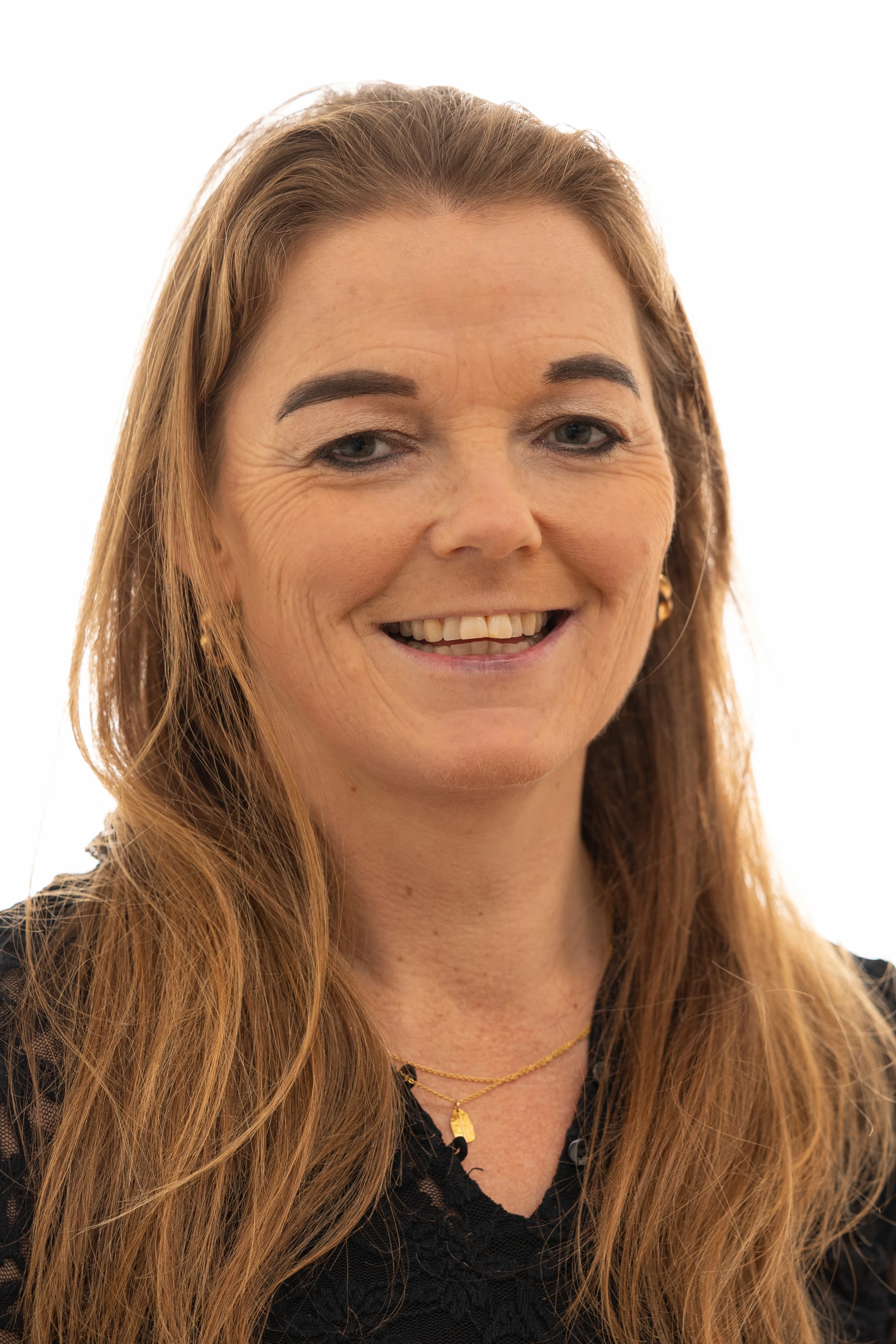
Karen Nielsen Breidahl
Karen N. Breidahl is an Associate Professor in the Department of Politics and Society at Aalborg University, Denmark. She specialises in the intersection of migration studies, comparative welfare state research, street-level bureaucracy, and public administration more broadly.
Currently, she is working on projects examining refugees’ encounters with frontline institutions and how these experiences shape trust and other important outcomes. She is also conducting research on, among others, misperceptions about migrants, how frontline organisations can serve as upward policy influencers, and the dilemmas associated with an increasing focus on temporality in migration governance.
What has the journal Nordic Welfare Research meant for you?
- Nordic Welfare Research has been an important venue for sharing welfare research from different perspectives across the Nordic countries. I particularly value the journal’s commitment to comparative and policy-relevant research that brings together scholars from across the Nordic welfare research community.
- Nordic Welfare Research has been an important venue for sharing welfare research from different perspectives across the Nordic countries. I particularly value the journal’s commitment to comparative and policy-relevant research that brings together scholars from across the Nordic welfare research community.
10. Frontline experiences of newly arrived refugees in Norway and Denmark
Vol.10, Iss.4 | pp 1–19 | 3 December 2025 | https://doi.org/10.18261/nwr.10.4.3
Abstract
The article examines the experiences of Syrian and Ukrainian refugees in their encounters with municipal integration workers in Norway and Denmark. The empirical analysis takes its point of departure in street-level bureaucracy (SLB) theory on how informal practices of frontline workers are crucial for the delivery of welfare policies. It also departs from the more classical focus within the SLB literature by focusing more explicitly on the experiences of the claimants and how these experiences vary across groups and policy regimes. Thus, it examines whether the differences between Norwegian and Danish integration policies at the national level – the latter being more restrictive than the former – transpire into refugees having different frontline experiences. The article relies on original survey data collected in Denmark and Norway among sub-samples of Syrian and Ukrainian refugees, respectively arriving from 2015 to 2023 and from 2022 to 2023 (n=6,551). The survey data enable us to assess refugees’ experiences of service quality, in this article measured as communication difficulties, whether they get the help they need, and changes in experienced self-worth following encounters with integration workers. The article finds that, overall, experiences of service quality are positive, but that differences exist across refugee groups and country of residence. The Syrian refugees in Denmark report the least positive experience with the municipal integration workers. We also find that a remarkable number of refugees report experiences of lower self-worth and communication problems. These negative experiences are more prevalent among refugees from Syria than Ukraine and more prevalent in Denmark than in Norway. Finally, the article finds that experiences of service quality are shaped by the individual resources that refugees are in possession of.
Introduction
Knowledge about personal encounters with the frontline of the (welfare) state is of crucial importance for policymakers and practitioners, as these experiences serve as a crucial test of whether formal policy intentions about user involvement, equity, etc., are substantiated in practice (Breidahl et al., 2021; Kumlin & Rothstein, 2010; Moynihan & Soss, 2014). Moreover, several studies have revealed how frontline encounters may have broader feedback effects on outcomes such as institutional trust and political engagement (Breidahl & Fersch, 2018; Bruch et al., 2010; Yeager et al., 2017).
The overall aim of this article is to offer new insights into how individuals’ experience their encounters with the frontline of the welfare state by focusing on the specific case of newly arrived refugees resettled in two Nordic welfare states, Norway and Denmark. In terms of theory, the article takes its point of departure in street-level bureaucracy (SLB) theory by recognizing how crucial the informal everyday practices of frontline staff are for the delivery of welfare policies. It also extends the reach of street-level research that predominantly focuses on the practices of frontline staff by paying explicit attention to the experiences of the claimants themselves, and how these experiences vary across policy regimes.
The focus on newly arrived refugees holds relevance for policymakers, researchers, and practitioners alike. Newly arrived refugees face numerous social and economic challenges due to their restricted citizenship rights, difficult labour market positions, and (in many cases) severe language barriers (Dånge, 2023; Spehar, 2021). In both Norway and Denmark, newly arrived refugees are subject to extensive – and at times intrusive – integration measures, reflecting the long-standing and deeply embedded tradition of strong state involvement of the Nordic welfare states (Breidahl & Fersch, 2018). This involves, among others, full-day introductory programmes that may last for up to four years (Breidahl, 2017). How newly arrived refugees experience these measures is therefore of crucial importance for the well-being of newly arrived refugees as well as for society at large. The aim of this article is to learn more about different aspects of frontline experiences by shedding light on the following two research questions:
- How do Syrian and Ukrainian refugees experience their encounters with municipal integration workers – and to what extent do these experiences vary between Norway and Denmark?
- To what extent are differences in experiences a reflection of the individual resources that the refugees are in possession of?
Examining these questions enables us to provide insights about refugees’ experiences of service quality: Do they feel they get the help they need, to what degree do they face difficulties communicating with the frontline of the welfare state and to what extent do their encounters involve psychological costs? As national-level public policies on migration and integration to some extent vary across the two countries (Breidahl, 2017), we also have an interest in whether these differences are reflected in the refugees’ experiences with the frontline staff. Finally, the heterogeneity of the refugee group also raises concerns for equity of services across not only refugee groups but also individual resources such as educational background and language proficiency.
We will direct attention to three dimensions of experiences of service quality, here referred to as communication efficacy, service outcome satisfaction and post-interaction self-worth. Understanding individuals’ experiences of these three dimensions is, we argue, vital for evaluating whether overall and sometimes abstract policy goals of effectiveness and equity are achieved in practice. In relation to this, the focus of question 2, the impact of individual resources is inspired by notions of “Equity” in welfare services: Access to and quality of welfare services should (in principle) be equal for all citizens and not differ according to ethnicity, gender, age, or educational level. Therefore, if the resources individuals are in possession of influence experiences of service quality, it is an indication of whether the Nordic welfare states live up to overall goals about equity. Systematically identifying these experiences, can generate valuable insights to policymakers and frontline organizations in their future efforts to improve public services.
The survey data includes 6,551 refugees, allowing us to direct attention to and engage in a broader discussion around the general patterns in how newly arrived refugees (in this study defined as individuals who within a period of 8 years have gained resident permit (2015–2023)) experience their encounters with the frontline of the Nordic welfare state. Moreover, the data allow us to examine variations in refugee experiences – by individual resources, by the refugees’ countries of origin (Syria and Ukraine), and by their countries of residence (Denmark and Norway). Finally, the article also methodologically contributes to existing SLB research. While in-depth qualitative studies on individual experiences offer important insights, quantitative research based on representative samples is so far scarce and may add supplementary and valuable insights.
The rest of the article is structured as follows: The next section presents the theoretical framework and related research that underpin the focus of the article, followed by an outline of the central features of the policy context of Syrian and Ukrainian refugees in Denmark and Norway. The fourth section introduces the data, measures, ethical considerations and methods, followed by the empirical analysis. The last section summarizes the central findings and discusses their limitations and broader relevance.
Theoretical framework and previous studies
In terms of theory, the article takes its point of departure from insights into SLB theory: how policy is produced on the ground by frontline staff, and the ways their frontline practices matter for the clients (Breidahl & Brodkin, 2024; Lipsky, 1980). Thus, street-level organisations, and the staff within those organizations, shape possibilities for accessing services, benefits, and rights provided by the state.
Although it is widely recognized that what frontline staff do, and do not do, is of importance for the clients (Brodkin, 2011; Lipsky, 1980), most SLB studies tend to focus on the staff side – their behaviour, informal practices and strategies to manage everyday working life. Less is known about the claimant side – how they experience their personal encounter with the frontline in various areas of the (welfare) state, and what shapes these experiences (for some previous studies, see Boland & Griffin, 2015; Breidahl et al., 2024; Finn, 2021; Matarese & Caswell, 2018; Wright et al., 2020).
Looking beyond the SLB literature, several migration studies have drawn attention to the experiences of immigrants in their new destination country. This covers a long line of quantitative (Breidahl et al., 2021; Crul & Schneider, 2010) as well as qualitative studies (Bucken‐Knapp et al., 2019; Schierenbeck et al., 2023; Spehar, 2021). These studies have, among others, brought forward some of the “voices” and lived experiences of different groups of migrants. Some focus specifically on refugees’ experiences with introduction programmes (e.g., Bucken‐Knapp et al., 2019; Djuve & Kavli, 2015), others more broadly on migrants’ experiences with the destination society institutions (e.g., Breidahl et al., 2021; Röder & Mühlau, 2012). We contribute to this literature by focusing specifically on the refugees’ encounters with frontline staff and by drawing on analytical insights from the administrative-burden literature on how clients encounters with the administrative side of the state can involve a considerable amount of cost and how these costs are distributed unequally across different groups (Herd & Moynihan, 2018). When citizen-state encounters are experienced as burdensome, it makes it harder for citizens to access services – especially for the least advantaged groups in society. Consequently, personal encounters with state authorities can be experienced as more or less “burdensome”. According to the literature, these burdens are manifested in different categories of costs, such as compliance costs (e.g., burdens of following administrative rules), psychological costs (e.g., stigma, loss of self-worth and loss of autonomy due to entering specific programmes) and learning costs (e.g., time and energy spent on learning rules and requirements) (Herd & Moynihan, 2018).
Considering the extensive trauma that many refugees are exposed to prior to and during displacement, and their subsequent vulnerability to re-traumatization, we find it imperative to critically examine the psychological costs of their everyday encounters with the frontline of the welfare state (Ojha et al., 2024). Psychological costs embrace many dimensions. They are manifested in different emotions such as stress and frustration and are closely related to both compliance and learning costs and may arise as direct consequences of these (Herd & Moynihan, 2018, p. 27). To capture psychological costs in this article, we will focus on the “implications for self-worth”. We will also examine “communication efficacy” – did the refugees understand what the integration workers said? We argue that this captures an important element of learning costs, although it departs from more conventional measures like time and energy spent on learning. Our data does not include measures of compliance costs. Instead, we focus on a broader measure of “service outcome satisfaction” that supplement the other more specific dimensions in important ways. In the concluding discussion, we will address how additional research can add to current studies on administrative burdens experienced by refugees.
The policy context of Syrian and Ukrainian refugees in Denmark and Norway
As mentioned above, the survey data enables us to systematically compare refugees’ experiences with the frontline across two Nordic welfare states, both of which are known for their institutional capacity to provide and advance social welfare (Esping-Andersen, 1990), but which have also consistently struggled over the past decade to respond to refugees seeking protection and opportunities for a better life (Breidahl, 2017). Denmark and Norway differ in their approach to refugees, and in the services targeted specifically at newly arrived refugees (Hernes et al., 2023).
Both countries have enacted integration laws that mandate participation in integration programmes which, in practice, are compulsory for refugees reliant on state-provided financial support. These programmes typically include language training, social studies, and various training and measures that can prepare the participant for further education or work. The programmes typically last between six months and one to two years, but can in some cases last for up to four years.
Although these programmes share several similar features, Denmark is generally considered to be less generous in terms of rights to income support, and stricter in its demands to participate and perform in the programmes (Breidahl, 2017; Brochmann & Hagelund, 2012; Hernes et al., 2023). Previous research has offered limited comparative insight into how these general characteristics, both their divergences and commonalities, are reflected in the lived experiences of newly arrived refugees.
Upon arrival, the standard procedure in both Norway and Denmark is that asylum applicants are hosted in asylum centres while awaiting a decision on whether asylum will be granted. For some, this waiting period extends for not only months but years (Breidahl & Brodkin, 2024). When refugees from Syria arrived at the Danish and Norwegian borders, the majority were initially accommodated in asylum centres. In Denmark, the humanitarian crisis in Syria, combined with a high recognition rate and the group’s clear eligibility for protection, meant that refugees from Syria were, in comparison to asylum seekers from other countries, granted temporary residence more rapidly. As a result, their duration within the asylum system was comparatively shorter (Hvidtfeldt & Schultz-Nielsen, 2018).
In Norway, the average waiting time for Syrians varies more, ranging from more than 16 months in 2019 to 4.5 months in 2022
.
IMDi: Monthly report on settlement, December 2019; January 2023
Unlike other refugee groups, Ukrainian nationals were granted temporary protection status upon arrival in Denmark and Norway, thereby circumventing the formal asylum application process. Compared to Syrian refugees, they benefited from a faster and more streamlined process for obtaining temporary protection status, which also granted them immediate access to the labour market in both Denmark and Norway. Thus, although the waiting time in the asylum system for Syrian refugees, at least in Denmark, was relatively short compared to other refugee groups, Ukrainian refugees were settled in local municipalities at a higher speed (Nordic Council of Ministers, 2022). That said, the continued high influx of Ukrainian refugees in Norway has in some cases delayed enrolment in introductory programmes as well as reduced the scope of the programme due to limited capacity in the integration services (Kavli et al., 2024). By the end of 2023, Norway had received more than 63,000 refugees from Ukraine. The corresponding number in Denmark was below 47,000
, and the difference in arrivals continued through 2024.
Facts and figures on immigration 2023. https://us.dk/tal-og-statistik/tal-og-fakta/
Once resettled in a municipality, refugees have access to various training programmes mainly aimed at learning the language, social studies, and most importantly finding – or becoming qualified for – paid employment. The main income support available for newly arrived refugees is the introductory benefit, which is conditioned on participation in the programme. While Denmark and Norway share some fundamental features in their integration and labour market systems, Denmark generally enforces stricter sanctions and civic integration measures, emphasizes a stronger “work-first” approach in its activation policy, and employs a two-tier social benefits system that provides significantly lower benefits for migrants compared to non-migrants (Breidahl, 2017; Djuve & Kavli, 2019). Moreover, Denmark has a stronger emphasis on return and repatriation policies than Norway (Hernes et al., 2023). In Denmark, this was manifested as part of the so-called “paradigm shift” enacted in parliament in 2019. Consequently, the Danish integration law includes two sets of programmes – the introductory programme and the self-sufficiency and repatriation programme
. Norway has not undertaken a similar turn towards temporary protection in its regular asylum and refugee policies. However, after Russia’s full-scale invasion of Ukraine in 2022, Norway received an unprecedented number of Ukrainian refugees, including many children, who were granted collective temporary protection.
Udlændinge og Integrationsministeriet: Selvforsørgelses- og hjemreiseprogrammet og introduktionsprogrammet. https://uim.dk/arbejdsomraader/integration/modtagelse-og-integration-af-nye-borgere/den-beskaeftigelsesrettede-integrationsindsats/selvforsoergelses-og-hjemrejseprogrammet-og-introduktionsprogrammet/
Data and methods
Data
The data utilized in this article stems from an original survey conducted in late 2023 to early 2024 by Statistics Denmark and Kantar Public/Verian in Norway
. The survey focused on Syrian and Ukrainian refugees resettling in Denmark or Norway. Inclusion criteria for Syrian refugees were 1) arrived in Norway/Denmark between 2015–2023, 2) hold Syrian citizenship upon arrival in host country, 3)–18 years or older, 4) hold residence permit either from being granted asylum or through family reunification. For Ukrainian refugees, inclusion criteria were 1) arrived in Norway/Denmark between 2022–2023, 2) hold Ukrainian citizenship upon arrival, 3)–18 years or older and 4) granted residence permit under temporary collective protection schemes for Ukrainian refugees in Norway/Denmark.
For more detailed descriptions of the data, see technical report (Nielsen et al. 2025)
It is widely recognized that refugees can be hard to reach through survey research, so several measures were taken to improve the response rate. First, the web interview was translated from Danish/Norwegian to Ukrainian, Russian and Arabic. The translations were tested by native speakers who discussed the quality of the translations with the researchers before the surveys were piloted. Second, answers were collected through a combination of web interviews (CAWI) and phone interviews (CATI). Invitations were sent out by email or SMS and several reminders were sent if they had not participated initially. A second round of data collection was conducted through phone interviews for those who were either non-responsive or had partially completed the survey. Third, phone interviewers were competent in either Ukrainian/Russian and/or Arabic, enabling direct interviewing. Fourth, cash prices were raffled among the participants in the survey. These steps helped ensure satisfactory response rates for each subgroup included (see Table 1 in the supplementary materials).
Appendix 1 reports an overview of the present sample, interview method and background characteristics. The overall response rate for both countries is 24.5% and the data holds 6,551 fully completed interviews. The response rate is higher in the Danish survey (21.0% vs. 32.6%). This is due to a – by comparative standards – low response rate for Syrian refugees in Norway (13.4%). The phone interviews did, however, increase the response rates for Syrian refugees in Norway, reflected by the fact that 46% completed the interview by phone (see Appendix 1.2).
Appendix 1.5 shows the characteristics of the sample, revealing notable differences between refugees in Norway and Denmark. In Denmark, the percentage of Syrian and Ukrainian refugees employed full time is higher compared to Norway, while a greater proportion of refugees in Norway are enrolled in education. Syrian and Ukrainian refugees in Denmark have, on average, resided in the country for a longer duration compared to their counterparts in Norway. Over half of the Ukrainian refugees in both countries have higher education, unlike the Syrian refugees, who generally have lower educational levels. In Denmark, the proportion of female refugees is higher than in Norway in both refugee groups, while in both countries, the largest share of Syrian and Ukrainian refugees falls within the 26–45 age group. However, a larger proportion of Ukrainian refugees in both countries are aged 56 and above compared to their Syrian counterparts.
Measures
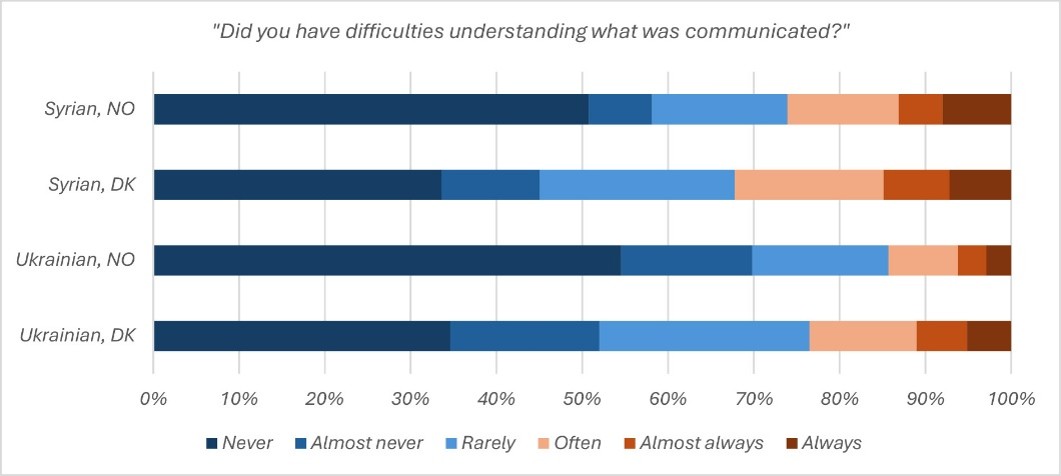
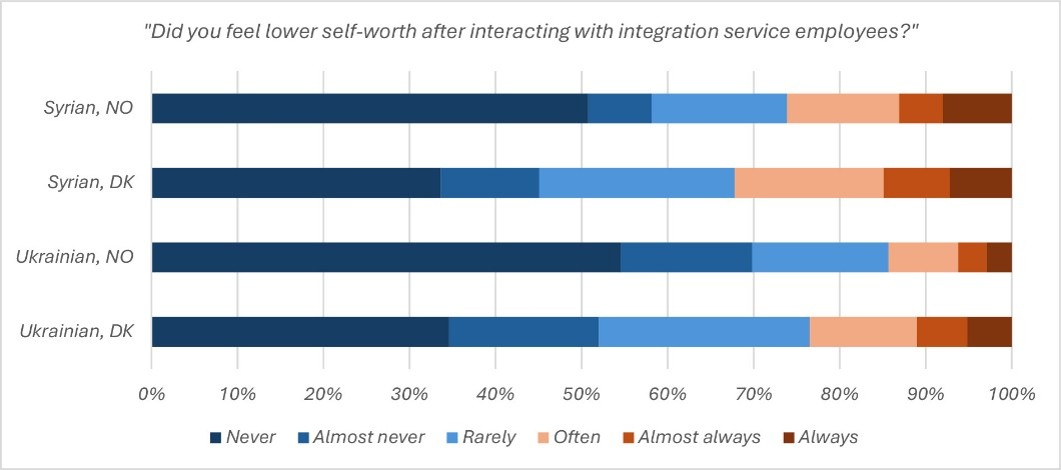
As shortly discussed above, the empirical analysis of the article will direct attention to three dimensions of experiences of service quality: communication efficacy, service outcome satisfaction, and post-interaction self-worth. First, given that many newly arrived refugees face language barriers, we consider difficulties around communication to be a crucial dimension of service quality and as one of several manifestations of burdensome experiences. Communication efficacy was measured by asking “Did you have difficulties understanding what was communicated (by integration workers)?”. The second dimension of “service outcome satisfaction” was measured by asking “Did you receive the help you needed (from the integration workers)?” Finally, we have added a measure of negative implications of frontline encounters on refugee’s post-interaction self-worth (psychological costs) by asking “Did you feel lower self-worth after interacting with integration service employees?”.
Together, these three measures offer relevant insights into refugees’ experience of service quality in their interactions with frontline integration workers. The three measures combine both specific and general assessments of encounters with integration workers. The measures also entail certain limitations, including recall bias (e.g., referring to how the respondent’s ability to accurately remember past events becomes flawed over time). The way we measure “communication efficacy” only captures whether the respondents understood the communication from the integration workers, whereby other relevant dimensions of communication are omitted, e.g., whether the refugees have the ability to voice their concerns, etc.
Respondents answered all three questions on six-point scales ranging from “Never” to “Always” (Never/Almost never/Rarely/Often/Almost always/Always). To ease interpretation in the regression analyses, the variables were rescaled to range from 0 to 100, entailing that the theoretical minimum equals 0 and theoretical maximum equals 100.
To investigate “equity” in refugees’ encounters with welfare services, we direct attention to the role of individual resources. In an ideal scenario, equity in welfare services would entail that individual-level factors have limited influence on refugees’ experiences of service quality: Thus, if welfare services are genuinely accessible and effective for all, we would not expect to observe significant variations in experiences across individuals and groups. The greater the group-based disparities in perceived service quality, the more it signals a shortcoming in the pursuit of equity.
The following individual-level predictors of experiences of service quality are utilized in the empirical analysis: English language proficiency (Beginner/Elementary/Low intermediate/Intermediate/Advanced/Very advanced), host-country language proficiency (Beginner/Elementary/Low intermediate/Intermediate/Advanced/Very advanced), educational attainment (Primary and lower secondary/Vocational training and general upper secondary/Higher education)
. We include controls for age and gender, as there are substantial disparities in the distribution of both across the included refugee groups (see Appendix 1.5 for an overview of background characteristics).
Time of residence was initially included in the analysis, but was exempted from the model due to problems of multicollinearity in the Danish sample between refugee group and years of residence. The majority of the Ukrainian refugees in Denmark arrived within the first three months after the Russian escalation, whereas the influx of refugees to Norway has continued throughout the period.
Ethical considerations
In developing and conducting a survey on refugees’ experiences with municipal integration workers, it is vital to maintain responsibility and respect. We contend that our study generates important knowledge with the potential to inform and improve societal outcomes, but, of course, this aim must always be balanced against the principle of “do no harm”. To minimize potential negative impacts, we have taken the following steps:
- Informed consent and voluntary participation: Information about the purpose of the study, what it involves, and any potential risks or benefits has been provided in Norwegian, Danish, English, Ukrainian and Arabic. Participation has been clearly stated as voluntary, and participants have been informed that they may withdraw from the study at any time.
- Confidentiality and anonymity: The identities of the participants are anonymized in the data used for analysis, and the data collected is stored securely and only accessible to authorized personnel.
- Sensitivity to trauma: The questionnaire has been developed mindful of the potential for refugees to have experienced significant trauma. Questions are respectful and topics that may re-traumatize or resemble asylum interviews are avoided.
- Cultural sensitivity: The survey is available in multiple languages, and the questions have been reviewed to ensure cultural appropriateness.
Analyses
Descriptive statistics are utilized to assess cross-country and cross-group variations in refugees’ frontline experiences. Descriptive results are visualized in graphs, while numeric tables are available in Appendix 2. Partial responses are included. The descriptive analyses are conducted for each of the three dimensions of experiences of service equality. Linear regression analyses (OLS) are used to assess “equity” – whether and how individual-level factors affect frontline experiences across countries and groups.
To explore whether the importance of individual-level resources is more pronounced in Denmark than in Norway, we first constructed a binary variable with refugee groups pooled together according to country of residence. Second, a set of regression analyses predicting associations between individual-level resources and the three dimensions of frontline experiences was conducted, including an interaction term between country of residence and each individual-level resource of concern. These are education level, English language proficiency, and country-of-residence language proficiency. Regression tables, tables reporting numeric slope coefficients, and visual representations of interaction effects are reported in Appendices 4 and 5. Missingness is handled by listwise deletion. All regression models were subject to tests for heteroskedasticity (White test), multicollinearity (variance inflation factors), influential cases (Cook’s D) and appropriate functional form (Ramsey’s regression specification error test). Due to heteroskedasticity problems, robust standard errors are used throughout. Besides heteroskedasticity problems, tests indicate no violation of OLS assumptions. However, the regression models predicting service outcome satisfaction demonstrated borderline significant results, indicating potential deviances from linearity. Visual analyses using augmented partial residual plots identified that the variable capturing country-of-residence language proficiency deviates a little from normality, causing Ramsey’s regression specification error test to indicate a non-appropriate functional form. Treating country-of-residence language proficiency as categorical did not yield substantially different results. To ease interpretation of results across regression models, and because there are only minor deviations from linearity, the variable was treated as continuous.
Results
Descriptives
Most refugees report generally positive experiences of service quality in their interactions with municipal integration workers (cf. Figures 1.1 to 1.3). In terms of communication difficulties (communication efficacy), most refugees report that they rarely or never have difficulties understanding what was communicated by the local integration workers. However, Syrians in both Norway and Denmark report more frequent communication difficulties than Ukrainians.
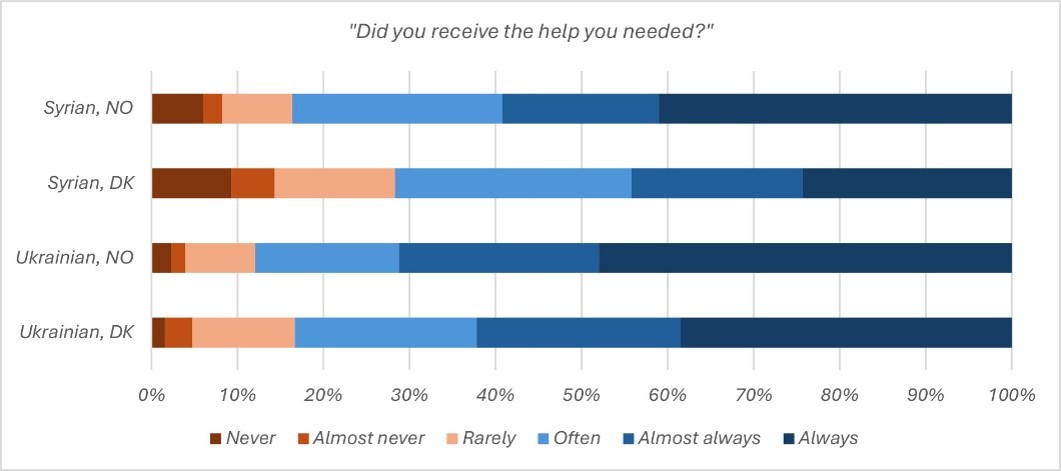
In terms of service outcome satisfaction, a large majority report that they always, almost always or often receive the help they need after being in contact with integration workers. However, again, we find that the expressed satisfaction is lower among Syrians in Denmark compared to the other groups, as 9.3% indicate that they “never” got the help they needed when being in contact with integration workers.
In terms of psychological costs (post-interaction self-worth), Syrians, especially in Denmark, report the highest level of costs after being in contact with integration workers. Although most Syrians in Denmark say they rarely or never experience a drop in self-worth, it is notable that 30% state that they often or always feel lower self-worth.
The measurement of psychological costs is compromised by the unknown and likely variation in time elapsed between the respondent’s last interaction with integration workers and the time of data collection. This can increase the likelihood of recall bias, as evaluations of frontline encounters in the past may be blurred by more recent experiences – positive as well as negative – with other areas of the society. To address this potential recall bias, we assess the association between non-institution-specific expectations of equal treatment by country-of-residence authorities and psychological costs for each refugee group
. Using Goodman & Kruskal’s gamma statistics, we found moderate associations across all groups (Syrian (NO) = .29; Syrian (DK) = .28; Ukrainian (NO) = .39; Ukrainian (DK) = .36). If our measure of psychological costs primarily reflected a general sense of resettlement, we would expect stronger associations. The observed strength of the associations therefore suggests that our measure captures aspects of psychological costs that are, to some extent, distinct from a broader perception of equal treatment.
Expectations of equal treatment by country-of-residence authorities were measured by asking “How likely is it that people will receive equal treatment when contacting government authorities in Denmark/Norway?”. Respondents answered on a four-point scale (Very unlikely/Unlikely/Likely/Very likely).
The descriptive findings outlined above reveal substantial differences across refugees’ countries of origin as well as between destination countries. Across all three measures, the experiences of service quality tend to be more positive in Norway than in Denmark. Nevertheless, in both host countries, Syrians express higher levels of dissatisfaction concerning the assistance they receive and lower feelings of self-worth after interacting with municipal integration workers. Furthermore, Syrians encounter severe communication difficulties than Ukrainians in both Denmark and Norway. These national differences could indicate that differences in the policy regimes and how municipal integration workers deliver these policies, may have an impact on refugees’ experiences of service quality. Furthermore, services appear to cater more effectively to the needs of Ukrainian refugees compared to Syrian refugees.
Equity of welfare services: Individual-level predictors of experiences
In both Norway and Denmark, the ethical foundation of social work emphasizes equal treatment of all individuals, regardless of their cultural background or personal resources. The regression analyses reported in Figure 2 predict the impact of individual-level factors related to refugees’ experiences with frontline municipal integration workers (see Appendix 3.1 for numeric regression table).
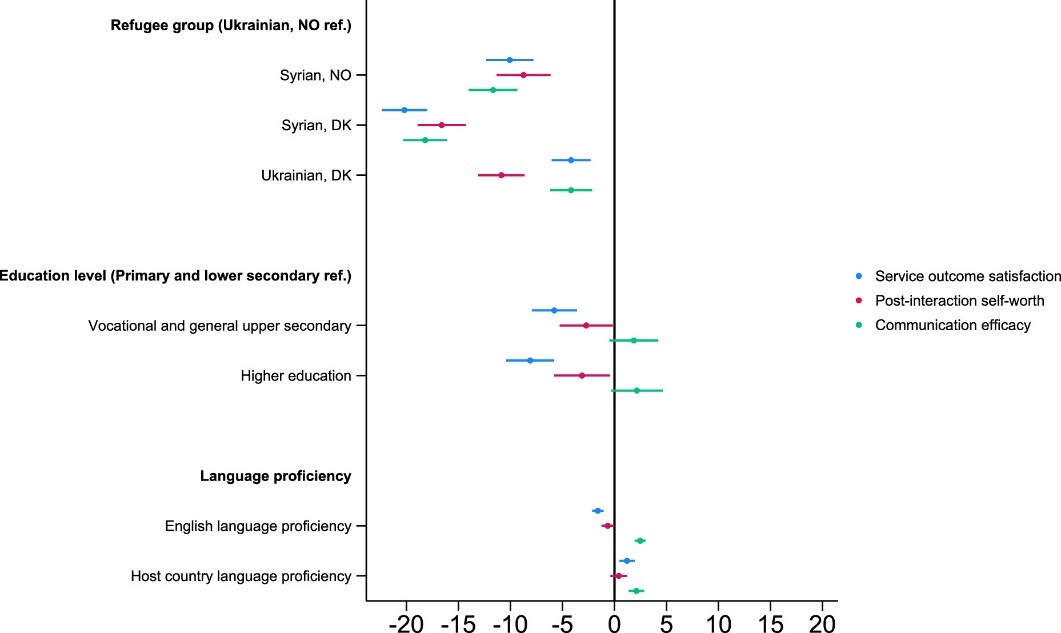
After controlling for individual characteristics, Syrian refugees in Denmark consistently score lowest across all three measures. This suggests that they have the least positive experiences with municipal integration workers, whereas Ukrainian refugees in Norway report the most positive experiences. In other words, differences based on both country of origin and country of residence persist after controlling for individual-level factors. Moreover, the analysis reveals that various individual-level factors influence refugees’ experience of service quality. English language proficiency and educational level tend to decrease experiences of service outcome satisfaction and increase psychological costs. The effect is most evident in terms of service outcome satisfaction which may reflect that more resourceful refugees may have higher expectations for service quality. The same resources do, however, tend to increase perceived communication efficacy. Across all three measures, older refugees tend to report more positive experiences than their younger counterparts. It is difficult to determine whether this pattern reflects higher expectations among younger refugees – for instance, regarding access to formal education – or whether integration workers find it easier to address the needs of older refugees, or perhaps a combination of both.
To summarize, the analysis highlights two central findings: Experiences of service quality among refugees are indeed affected by individual resources, and the cross-country and within-country patterns identified in the previous section persist even after controlling for language proficiency, educational attainment, age, and gender.
The link between policy regimes and equity of services
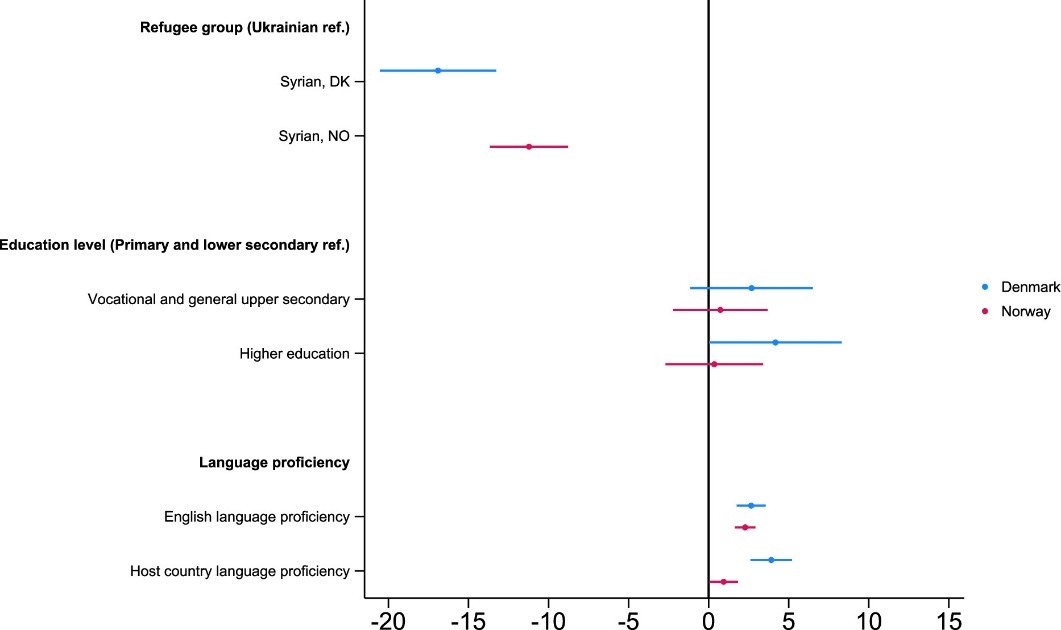
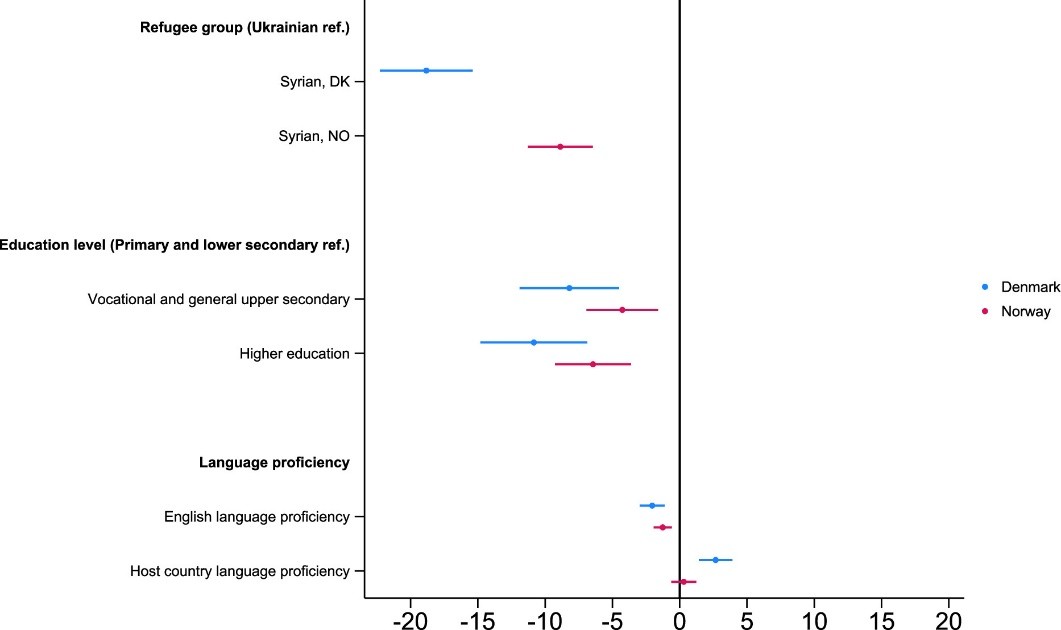
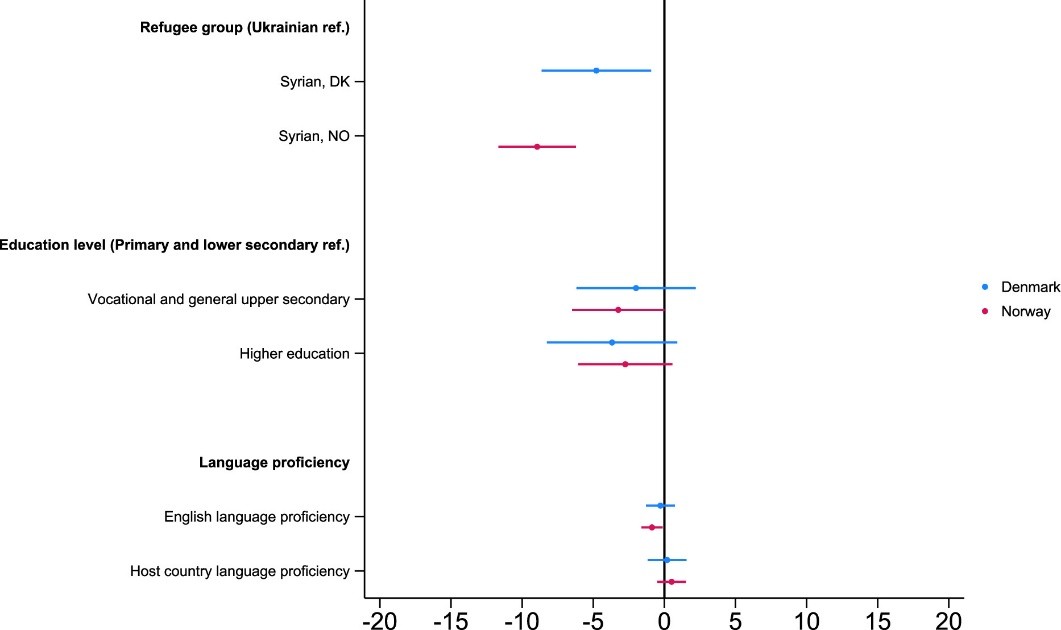
To assess whether differences in frontline experiences of service quality across policy regimes are statistically valid, we first conduct a regression analysis with the refugee groups pooled together by country of residence (see Appendix 3.3 for numeric regression table). Across all three measures of service quality, refugees resettled in Norway report, on average, more positive experiences than those resettled in Denmark (Service outcome satisfaction = 9.803***; Psychological costs = 11.33***; Communication efficacy = 8.301***). Given that the dependent variables are scaled from 0 to 100, this suggests that refugees resettled in Norway report experiences that are approximately 8–11% more positive than those of refugees resettled in Denmark. Second, to shed light on policy regime effects on the level of equity of services, we conduct separate regressions for refugees in Norway and Denmark. This allows us to assess whether there are larger disparities in frontline experiences across ethnic origin in Denmark than in Norway. Should one regime better reflect the ideal of equity in provision of welfare services, this would be evident in a weaker influence of individual-level characteristics on refugees’ reported experiences. Alternatively, we would expect that the size of the effects is smaller in one regime than in the other. Visually, the regime with the most equitable services would produce a “narrower” pattern in the figures that illustrate the findings from the regression analyses.
Figures 3.1 to 3.3 contains two separate OLS regressions each and compares the experiences of Syrian refugees in Denmark and Norway with those of Ukrainian refugees in these same countries.
Overall, the findings indicate that Norway, relative to Denmark, tends to come closer to the ideal of providing equity in welfare services: across all three measures of frontline experiences of service quality, individual-level characteristics tend to be of greater importance for refugees resettling in Denmark. Moreover, and in line with the previous findings, country of origin has a substantially larger impact on frontline experiences in Denmark. Here, there are larger differences between Syrian and Ukrainian refugees in their frontline experiences, both in terms of satisfaction with service outcomes and communication effectiveness.
Third, we assess whether there are statistically significant country differences regarding levels of service equity. Appendices 4 and 5 reports both numeric tables and visual representations of the additional tests of regime impacts, i.e., tests of whether the identified differences reported in Figures 3.1 to 3.3 are statistically significant. The findings show that two statistically significant interaction effects can be identified regarding experienced communication efficacy. Thus, education level and English language proficiency have less impact on refugees perceived communication effectiveness in Norway. Moreover, these findings reveal how the country differences in experienced communication efficacy become more pronounced as education and language skills decrease (see Appendix 5 for visual representations). This implies that refugees with a high level of individual resources experience somewhat similar communication efficacy across Norway and Denmark, while there are greater differences for refugees with less resources. When assessing the slope coefficients for the remaining cases, where p-values of the interaction term exceed 0.05, the same broad trend is identified (see Appendix 4.4). For instance, a statistically significant effect from education level on service effectiveness is identified in Denmark (-2.030*). Conversely, a smaller and non-significant effect is identified in Norway (-1.066).
In summary, the main findings from this section are that
1) refugees’ frontline experiences are generally worse in Denmark than in Norway and
2) these experiences tend to be more equitable in Norway, particularly regarding communication effectiveness and satisfaction with service outcomes.
Conclusion and discussion
The central aim of this article has been to shed light on how newly arrived refugees experience their encounters with the frontline of the welfare state in Denmark and Norway, by examining experiences of service quality across countries of origins, countries of residences and individual characteristics. The focus has been on refugees’ experiences with the frontline staff delivering municipal integration services as these services constitute formative encounters for newly arrived refugees in the Nordic welfare states.
The overall findings indicate that the majority of Syrian and Ukrainian refugees view the municipal integration services they encounter in a generally positive light. Still, not all refugees are satisfied. Some find that dealing with integration services comes at a psychological cost, and many feel worse about themselves after meeting with integration workers: 30% of Syrian refugees in Denmark and 24% in Norway report that they “always, almost always, or often” feel less self-worth after their encounters with integration workers. These variations across groups and countries remain when accounting for individual resources. Although at this stage we can only speculate, these findings could indicate that cross-national policy differences in restrictiveness, Denmark being more restrictive than Norway, matter for frontline practices in the municipalities. The findings underscore the necessity for further research to elucidate why psychological costs are disproportionately experienced by Syrian refugees compared to Ukrainian refugees, and more prevalently in Denmark than in Norway. Additionally, such research should explore how policy frameworks and frontline practices can be refined to mitigate these adverse experiences. We also encourage further research to incorporate the various types of costs commonly recognized in the literature on administrative burdens (see Section 2).
The empirical findings of this article further highlight significant challenges in the communication between refugees and frontline workers, particularly among Syrian refugees in Denmark. It is unsurprising that communication challenges arise when a large number of refugees arrive within a short timeframe, as acquiring proficiency in a new language requires time. Although both Denmark and Norway have national regulations guaranteeing newly arrived refugees the right to support from language interpreters – with Denmark adopting more restrictive measures than Norway – it is a well-established finding within SLB research that formal policy intentions are not necessarily implemented in practice, often due to factors such as resource constraints.
We encourage further research to investigate more deeply whether these communication difficulties reflect implementation barriers in the delivery of these services, whether it relates to the quality of the services or whether it rather reflects unproductive discretion – e.g., relying on Google Translate or other digital tools rather than professional interpretation services? The question is also whether these kinds of language services are enough to prevent the prevalence of communication difficulties.
We also observe cross-national differences between Norway and Denmark regarding experiences of service quality; refugees in Denmark more frequently report experiencing psychological costs, and communication with frontline workers tends to be more challenging. Findings that could indicate that features in the policy regimes systematically influence frontline practices and how individuals experience these practices. However, there is a risk that our findings are influenced by broader experiences of settlement in Denmark versus Norway. Factors such as Norway’s more generous social benefits may foster more positive attitudes towards public services, subsequently affecting refugees’ evaluations of their interactions with frontline staff in the municipalities. This also pertains to a broader limitation of the study, namely the potential bias inherent in soliciting satisfaction responses from newly arrived refugees. It cannot be ruled out that a certain degree of gratitude may influence their evaluations.
Our findings further suggest that neither Norway nor Denmark fully achieve the ideal of equity in service provision, as service quality is perceived differently depending on the individual resources refugees are in possession of. This also raises several questions for further research: Do the findings indicate that refugee-specific services in Norway and Denmark are better tailored to the needs of refugees with low education? Or do refugees with a certain level of education simply expect more from the services and are more likely to express their dissatisfaction when expectations are not met? When examining how individual resources shape perception of service quality we find that language skills are crucial and, moreover, that Syrian refugees in Denmark face more obstacles than Ukrainian refugees in Denmark, and Syrian and Ukrainian refugees in Norway. On the other hand, that individual resources matter is in many ways in line with previous research stating how individual resources influence personal encounters with state institutions and the (learning) cost involved in these encounters (Herd & Moynihan, 2018).
This underscores the critical importance of language proficiency. Effective communication remains a challenge in both countries, suggesting that many refugees lack adequate language skills to effectively navigate welfare state institutions, while frontline staff may encounter difficulties in addressing the needs of clients with limited proficiency in the host country’s language.
However, it is a paradox that improvements in language proficiency and educational attainment tend to improve perceived communication efficacy but reduce perceived service effectiveness. To provide high-quality welfare services at the street level, effective communication seems to be an important but insufficient condition.
Finally, and of critical importance, we encourage future research to undertake a more in-depth examination of why Ukrainian refugees generally report more positive experiences with frontline welfare state services compared to Syrian refugees. Although comparing differential treatment of refugee groups – and its implications – was not the primary focus of this study, our findings indicate that this area warrants greater scholarly attention in further research.
We have already discussed some of the limitations involved in a study like this, throughout the article. An additional limitation stems from the lack of information on variation across municipalities. In both Norway and Denmark, the local municipalities are responsible for delivery of integration services, and we know from previous research there are considerable local variations in the integration efforts and practices (Djuve & Kavli, 2015; Herd & Moynihan, 2018; Kavli et al., 2024). Nonetheless, our study reveals significant differences in how interactions with public services are experienced at the national level in Norway and Denmark. This suggests that variations at the municipal level do not eliminate the broader disparities observed between the two countries.
Notwithstanding the limitations inherent in the measures utilized in this study, we maintain that it offers significant contributions to the understanding of newly arrived refugees – a population that has been largely underexplored in the existing literature on experiences of service quality, street-level research and existing research on administrative burdens (cf. Halling & Baekgaard, 2024, for a recent literature review).
References
Boland, T. & Griffin, R. (2015). The death of unemployment and the birth of job-seeking in welfare policy: Governing a liminal experience. Irish Journal of Sociology, 23(2), 29–48.
Breidahl, K.N. (2017). Scandinavian exceptionalism? Civic integration and labour market activation for newly arrived immigrants. Comparative Migration Studies, 5(1), 2.
Breidahl, K.N. & Brodkin, E.Z. (2024). Managing asylum: Street-level organizations and refugee crises. Journal of Comparative Policy Analysis, 26(1), 42–63.
Breidahl, K.N., Brodkin, E.Z. & Miaz, J. (2024). The global challenge of mass migration and asylum: Comparative analysis of street-level organizations at the front lines. Journal of Comparative Policy Analysis: Research and Practice, 26(1), 1–9.
Breidahl, K.N. & Fersch, B. (2018). Bringing different states in: How welfare state institutions can possibly influence socio-cultural dimensions of migrant incorporation. Nordic Journal of Migration Research, 8(2), 99–106.
Breidahl, K.N., Hedegaard, T.F., Kongshøj, K. & Larsen, C.A. (2021). Migrants’ attitudes and the welfare state: The Danish melting pot. Edward Elgar Publishing.
Brochmann, G. & Hagelund, A. (2012). Immigration policy and the Scandinavian welfare state 1945–2010. Palgrave Macmillan.
Brodkin, E.Z. (2011). Policy work: Street-level organizations under new managerialism. Journal of Public Administration Research and Theory, 21(Supplement 2), i253–i277.
Bruch, S.K., Ferree, M.M. & Soss, J. (2010). From policy to polity: Democracy, paternalism, and the incorporation of disadvantaged citizens. American Sociological Review, 75(2), 205–226.
Bucken‐Knapp, G., Fakih, Z. & Spehar, A. (2019). Talking about integration: The voices of Syrian refugees taking part in introduction programmes for integration into Swedish society. International Migration, 57(2), 221–234.
Crul, M. & Schneider, J. (2010). Comparative integration context theory: Participation and belonging in new diverse European cities. Ethnic and Racial Studies, 33(7), 1249–1268.
Djuve, A.B. & Kavli, H.C. (2015). User influence in activation programs. When carers and clerks meet pawns and queens. Journal of Social Policy, 44(2), 235–254.
Djuve, A.B. & Kavli, H.C. (2019). Refugee integration policy the Norwegian way – Why good ideas fail, and bad ideas prevail. Transfer: European Review of Labour and Research, 25(1), 25–42.
Dånge, L. (2023). Taking control and reorienting future aspirations: how young refugees in Denmark navigate life between integration and repatriation. Journal of Ethnic and Migration Studies, 49(3), 655–672.
Esping-Andersen, G. (1990). The three worlds of welfare capitalism. Princeton University Press.
Finn, P. (2021). Navigating indifference: Irish jobseekers’ experiences of welfare conditionality. Administration, 69(2), 67–86.
Halling, A. & Baekgaard, M. (2024). Administrative burden in citizen–state interactions: A systematic literature review. Journal of Public Administration Research and Theory, 34(2), 180–195.
Herd, P. & Moynihan, D.P. (2018). Administrative burden: policymaking by other means. Russell Sage Foundation.
Hernes, V., Danielsen, Å., Łukasiewicz, K., Tvedt, K., Pachocka, M., Staver, A., Yeliseyeu, A., Zschomler, S., Mette, M., Berg, L., Nowicka, M., Koikkalainen, S., Kazepov, Y., Ferdoush, M.A., Berthelot, B., Virkkunen, J., Franz, Y. & Tronstad, K. (2023). Governance and policy changes during times for high influxes of protection seekers (NIBR Report 2023:20). NIBR. https://oda.oslomet.no/oda-xmlui/handle/11250/3112660
Hvidtfeldt, C. & Schultz-Nielsen, M.L. (2018). Refugees and asylum seekers in Denmark 1992–2016 (Study Paper No. 133). The Rockwool Foundation Research Unit.
Kavli, H., Bråten, B., Dapi, B. & Volckmar-Eeg, M.G. (2024). Var det oppskriften som manglet? (fafo-report 2024:09.). Fafo.
Kumlin, S. & Rothstein, B. (2010). Questioning the new liberal dilemma: Immigrants, social networks, and institutional fairness. Comparative Politics, 43(1), 63–80.
Lipsky, M. (1980). Street level bureaucracy: Dilemmas of the individual in public services. Russell Sage Foundation.
Matarese, M.T. & Caswell, D. (2018). “I’m Gonna Ask You About Yourself, so I Can Put It on Paper’: Analyzing Street-Level Bureaucracy through Form-Related Talk in Social Work”. The British Journal of Social Work, 48(3), 714–733.
Moynihan, D.P. & Soss, J. (2014). Policy feedback and the politics of administration. Public Administration Review, 74(3), 320–332.
Nielsen, R.S.H., Friberg, J.H., Breidahl, K.N., Djuve, A.B., Larsen, C.A. & Kavli, H.C. (2025). Syrian and Ukrainian refugees’ experiences with the welfare state in Denmark and Norway: Technical report and preliminary findings from the MIGTRUST survey. Faforeport 2025:9.
Nordic Council of Ministers ( 2022). Implementation of temporary protection for refugees from Ukraine – A systematic review of the Nordic countries (Nord 2022:026).
Ojha, S., Thapa, S. & Thapa, S.B. (2024). Mental health problems among Syrian refugees in Nordic countries: a systematic review. Nordic Journal of Psychiatry, 78(7), 561–569.
Röder, A. & Mühlau, P. (2012). Low expectations or different evaluations: What explains immigrants’ high levels of trust in host-country institutions? Journal of Ethnic and Migration Studies, 38(5), 777–792.
Schierenbeck, I., Spehar, A. & Naseef, T. (2023). Newly arrived migrants meet street-level bureaucrats in Jordan, Sweden, and Turkey: Client perceptions of satisfaction–dissatisfaction and response strategies. Migration Studies, 11(4), 523–543.
Spehar, A. (2021). Navigating institutions for integration: Perceived institutional barriers of access to the labour market among refugee women in Sweden. Journal of Refugee Studies, 34(4), 3907–3925.
Wright, S., Fletcher, D.R. & Stewart, A.B.R. (2020). Punitive benefit sanctions, welfare conditionality, and the social abuse of unemployed people in Britain: Transforming claimants into offenders? Social Policy & Administration, 54(2), 278–294.
Yeager, D.S., Purdie-Vaughns, V., Hooper, S.Y. & Cohen, G.L. (2017). Loss of institutional trust among racial and ethnic minority adolescents: A consequence of procedural injustice and a cause of lifespan outcomes. Child Development, 88(2), 658–676.