Chapter 2
The Nordic networks on deafblindness: their histories,
focus areas, and approaches
Establishing institutional networks to support the subjects and areas of focus is crucial to the work of the Nordic Welfare Centre in collaboration with the Nordic Leadership Forum on Deafblindness. These networks are an important aspect of the Centre's efforts.
The networks encompass a range of competencies and profiles, including subject specialists, researchers, and professionals from user associations and stakeholder organisations. They contribute by generating new knowledge and offering insights to decision-makers on areas that require further initiatives.
The networks encompass a range of competencies and profiles, including subject specialists, researchers, and professionals from user associations and stakeholder organisations. They contribute by generating new knowledge and offering insights to decision-makers on areas that require further initiatives.
Eight networks operate within the deafblind field under the Nordic Welfare Centre. Six of them participated in the network seminar in Malmö in November 2024.
The Nordic Network for Psychologists Working on Deafblindness and the Nordic Research Network on Deafblindness were the two networks not represented at the conference. More information on all eight networks can be found here.
The main task of the seminar was to conduct a new and unique way of doing video analysis. When all six of the networks present analysed the same video from their own perspective, the depth of the analysis reached new levels, showcasing the strengths of interdisciplinary work.
Before undertaking the video analysis, the networks were asked to present their focus areas, history, key milestones, and future plans. The following chapter of this report gives a presentation of each network in the same order and based on how representatives from the networks presented them during the seminar in Malmö.
Before undertaking the video analysis, the networks were asked to present their focus areas, history, key milestones, and future plans. The following chapter of this report gives a presentation of each network in the same order and based on how representatives from the networks presented them during the seminar in Malmö.
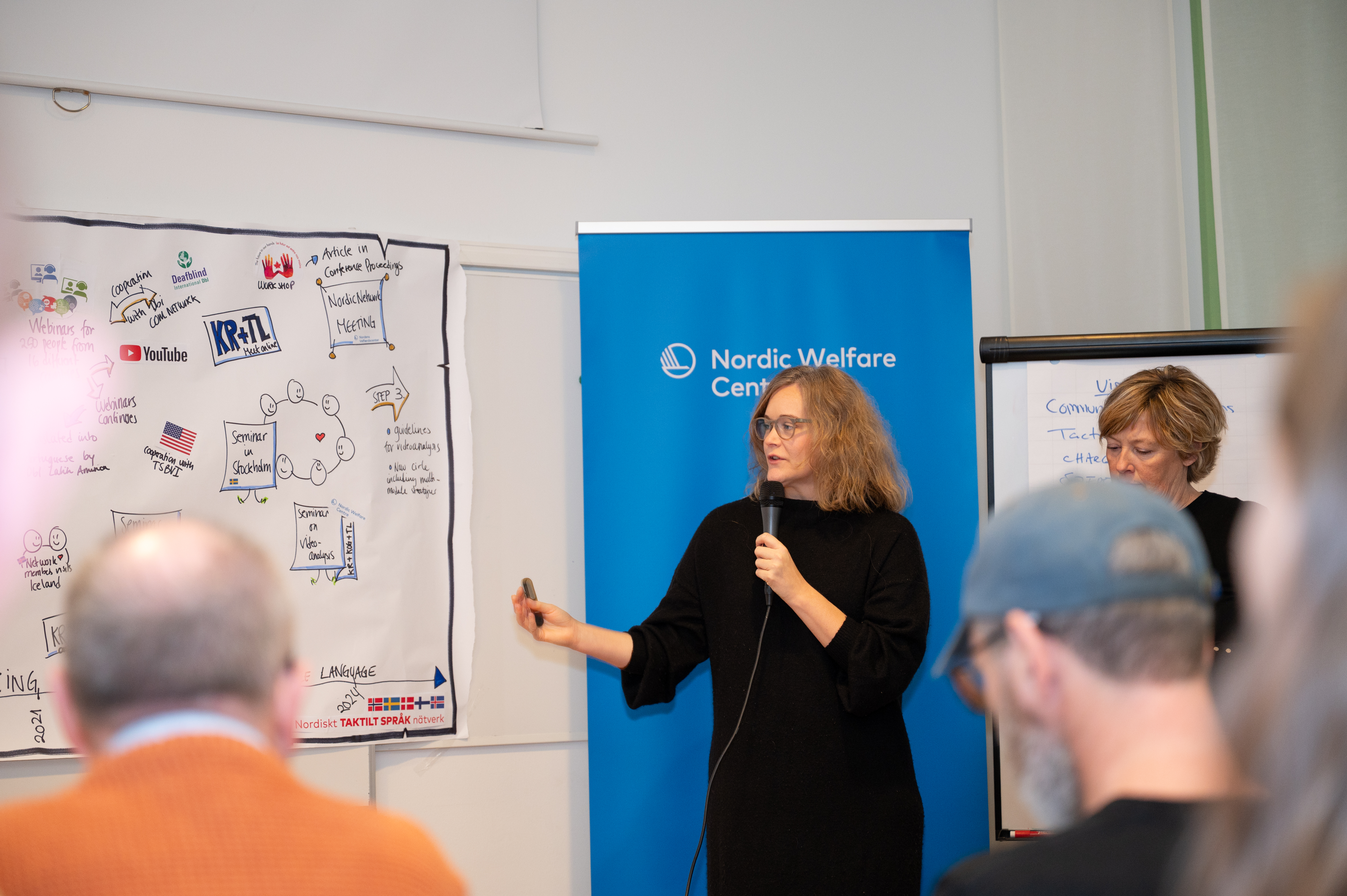
Photo: Sigve Nedredal
2.1 The Nordic Network on Communicative Relations
Within the deafblind field, Communicative relations refer to how individuals with congenital deafblindness can develop both communicatively and personally through interactive relationships with sighted and hearing partners.
The Nordic Network on Communicative Relations is guided by the United Nations Convention on the Rights of Persons with Disabilities, which affirms everyone’s right to be heard. People with disabilities are often part of a vulnerable group, relying on others to communicate, engage, and grow as individuals. The work of the Nordic Network on Communicative Relations focuses on supporting people in exercising their right to communicate through their own unique means.
The theoretical framework of the network’s approach centres on the book Communicative Relations by Inger Rødbroe and Anne Nafstad, published in 2013.
The network on Communicative Relations emerged from efforts to spread and communicate the findings of the book. Courses were organised to share the insights from the book, providing the foundation for the network's creation. To foster ongoing knowledge development and professional collaboration, the network was formally established in 2015.
Sanne Brink, a specialist in special education from Denmark, is one of the network's founding members.
– We use the models from the book as the foundation for our work. While some of these models are theoretical, we still define ourselves as a practice-oriented network, with a particular focus on supporting and inspiring interventions that foster communication with people with deafblindness. This is achieved through close collaboration with the staff who work directly with them.
Sanne Brink, a specialist in special education from Denmark, is one of the network's founding members.
– We use the models from the book as the foundation for our work. While some of these models are theoretical, we still define ourselves as a practice-oriented network, with a particular focus on supporting and inspiring interventions that foster communication with people with deafblindness. This is achieved through close collaboration with the staff who work directly with them.
Specialist psychologist Anne Nafstad, co-author of the book Communicative Relations, was an active member of the network for many years and continues to serve as a senior adviser. During the network's presentation at the seminar, she addressed the audience via video and answered the question of what the network has brought to her work.
– The network has contributed to a shared and universal discourse, allowing us to think about communicative development for congenital deafblindness from the same theoretical background, Anne Nafstad said.
One particularly important theoretical model central to the network's work is the Diamond Model, an intervention model used to analyse and support the communicative development of individuals with congenital deafblindness. The book Communicative Relations describes the model: “The Diamond focuses especially on the relational prerequisites for deafblind persons to develop communicative agency.”
– Many of the persons with congenital deafblindness never fully develop much cultural language. We try to focus on them being communicative, using their authentic expressions and voices. The Diamond Model really helps us to understand these authentic expressions, says Håkon Lie, a member of the network.
– The network has contributed to a shared and universal discourse, allowing us to think about communicative development for congenital deafblindness from the same theoretical background, Anne Nafstad said.
One particularly important theoretical model central to the network's work is the Diamond Model, an intervention model used to analyse and support the communicative development of individuals with congenital deafblindness. The book Communicative Relations describes the model: “The Diamond focuses especially on the relational prerequisites for deafblind persons to develop communicative agency.”
– Many of the persons with congenital deafblindness never fully develop much cultural language. We try to focus on them being communicative, using their authentic expressions and voices. The Diamond Model really helps us to understand these authentic expressions, says Håkon Lie, a member of the network.
One of the main theoretical focuses of the Network on Communicative Relations has been video analysis, carried out according to the principles outlined in the book Communicative Relations. This method provides a deeper understanding of individuals' unique ways of interacting and expressing themselves, which may not be readily apparent to partners due to the challenges of low readability.
– One of the most rewarding aspects of our network seminars is the video analysis we conduct together. We always find that it helps us make connections to our own practices. Video analysis is like a muscle—it must be strengthened to be maintained, Sanne Brink says.
– One of the most rewarding aspects of our network seminars is the video analysis we conduct together. We always find that it helps us make connections to our own practices. Video analysis is like a muscle—it must be strengthened to be maintained, Sanne Brink says.
The network highlights the importance of having a group leader to guide and facilitate the video analysis process, ensuring it is specific, useful, and conducted with respect to those featured in the video clips.
Sanne Brink emphasises the importance of conducting video analysis face-to-face. However, due to financial challenges and the travelling constraints of the pandemic, the network has not been able to meet as often as they would like. While they conduct video analysis online, which is less than ideal, they strive to meet in person at least once a year and online every two or three months.
Sanne Brink emphasises the importance of conducting video analysis face-to-face. However, due to financial challenges and the travelling constraints of the pandemic, the network has not been able to meet as often as they would like. While they conduct video analysis online, which is less than ideal, they strive to meet in person at least once a year and online every two or three months.
Over the years, the network has organised several courses, workshops, and webinars. In the future, it aims to continue the video analysis work to practise and sustain the knowledge within the network, enabling its further development and sharing.
The network is also working on an e-learning course to make the theoretical models from the book Communicative Relations more accessible to the general public.
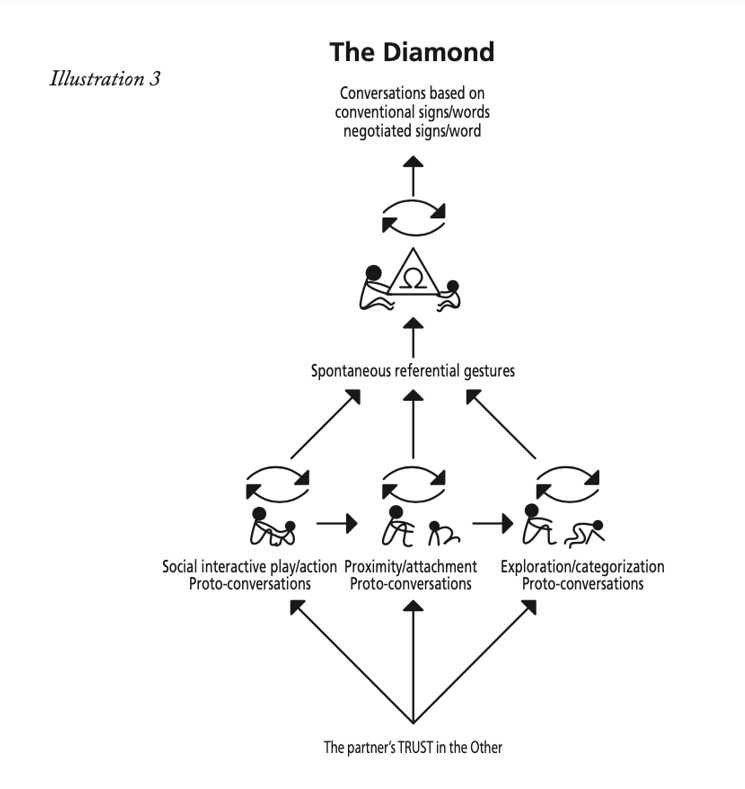
Picture: Diamond model
2.2 The Nordic Network on Tactile Language
All people are born with different capabilities, but everyone possesses an instinct to communicate with their fellow human beings, regardless of language or form of communication. This perspective is grounded in a dialogical approach, which assumes that all individuals wish to share their feelings, thoughts, and experiences with others. Creating the right conditions for individuals with congenital deafblindness to develop a language is complex.
The Network on Tactile Language began at a conference in Italy in 2009, where the question was raised: why do so few people with congenital deafblindness use sign language despite being exposed to signs?
The Network on Tactile Language began at a conference in Italy in 2009, where the question was raised: why do so few people with congenital deafblindness use sign language despite being exposed to signs?
The Nordic Staff Training Centre (NUD), which merged into the Nordic Welfare Centre that same year, initiated meetings, workshops, working groups, and seminars to gather knowledge on the subject.
–This continued until 2014, when the Nordic Network on Linguality was formalised. At that time, we did not refer to it as a tactile language but rather as something resembling a language, which is why the term "linguality" was used, explains network member Helle Buelund Selling.
During the same period, significant developments occurred within the field across the Nordics and Europe. The book Communicative Relations (mentioned in the previous chapter) was published, and many groups in the Nordic region were exploring tactile language. Master's students from the University of Groningen in the Netherlands, who examined the language through various modalities, also contributed to the knowledge base on tactile language.
A major breakthrough came in 2016 when Icelandic Sign Language linguist Nedelina Ivanova concluded that the "linguality" the network had been exploring met the language criteria.
– We found it very exciting. Ivanova discovered that this form of communication contains many small units that are similar to phonemes in spoken language or lexical units in sign language. The unit in the tactile language is called a “nema”, Helle Buelund Selling explains.
This breakthrough answered the question of why people with congenital deafblindness do not use sign language – they use a different language. The network began calling itself the Nordic Network on Tactile Language, and two years later, in 2018, the Scandinavian version of the book If You Can See It, You Can Support It, written by members of the network, was published, followed by an English version the following year.
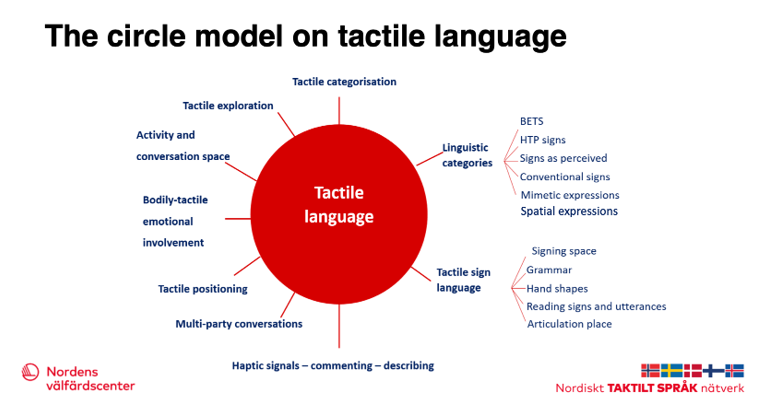
The book contains the Circle model for tactile language. The Circle model scaffolds and helps to understand and remember the many elements of tactile language. The model is presented as a dynamic tool and can be expanded to include new elements as knowledge of tactile language grows. This model has been a big part of the work that is done within the network.
–This continued until 2014, when the Nordic Network on Linguality was formalised. At that time, we did not refer to it as a tactile language but rather as something resembling a language, which is why the term "linguality" was used, explains network member Helle Buelund Selling.
During the same period, significant developments occurred within the field across the Nordics and Europe. The book Communicative Relations (mentioned in the previous chapter) was published, and many groups in the Nordic region were exploring tactile language. Master's students from the University of Groningen in the Netherlands, who examined the language through various modalities, also contributed to the knowledge base on tactile language.
A major breakthrough came in 2016 when Icelandic Sign Language linguist Nedelina Ivanova concluded that the "linguality" the network had been exploring met the language criteria.
– We found it very exciting. Ivanova discovered that this form of communication contains many small units that are similar to phonemes in spoken language or lexical units in sign language. The unit in the tactile language is called a “nema”, Helle Buelund Selling explains.
This breakthrough answered the question of why people with congenital deafblindness do not use sign language – they use a different language. The network began calling itself the Nordic Network on Tactile Language, and two years later, in 2018, the Scandinavian version of the book If You Can See It, You Can Support It, written by members of the network, was published, followed by an English version the following year.
The book contains the Circle model for tactile language. The Circle model scaffolds and helps to understand and remember the many elements of tactile language. The model is presented as a dynamic tool and can be expanded to include new elements as knowledge of tactile language grows. This model has been a big part of the work that is done within the network.
Since then, the network has focused on spreading the knowledge contained in the book through a webinar series based on its various chapters Webinars: Tactile Language - YouTube. The network has also collaborated with numerous experts within and beyond the Nordic region and presented their work at various conferences around the globe.
International collaboration has been invaluable, as the field of tactile language is too complex for any single country to develop independently. There is insufficient expertise in each country, and the population size is too small for national studies. Nordic Network on Tactile Language | NVC
– When the book was released, we deliberately left tactile language undefined. Claiming it was a language was challenging enough, as there was opposition to the idea. However, over the years, we have grown braver and have since developed a definition, Helle Buelund Selling says.
Network member Caroline Lindström shared the current suggestion for the definition of tactile language at the seminar.
– Tactile language is an early language in the making. It is a language used by people with CDB (congenital deafblindness). It is an authentic natural language from within. A language based on bodily engagement in the world. It is also a language that involves the tactile, kinesthetics, and proprioceptive senses.
The future of the network involves continuing to spread knowledge and refining the models in the book into practical tools.
– We would like to develop more guidelines and tools for video analysis based on the tactile language circle. A tool for using the circle would be helpful. Another plan is to further develop the circle from a more multimodal perspective, Caroline Lindström says.
– Tactile language is an early language in the making. It is a language used by people with CDB (congenital deafblindness). It is an authentic natural language from within. A language based on bodily engagement in the world. It is also a language that involves the tactile, kinesthetics, and proprioceptive senses.
The future of the network involves continuing to spread knowledge and refining the models in the book into practical tools.
– We would like to develop more guidelines and tools for video analysis based on the tactile language circle. A tool for using the circle would be helpful. Another plan is to further develop the circle from a more multimodal perspective, Caroline Lindström says.
2.3 The Nordic Network on CHARGE Syndrome
The Nordic Network for CHARGE syndrome was established in 2002, and has since focused on gathering, sharing, and disseminating knowledge about CHARGE syndrome while scientific advancements in the field have also progressed.
– In 2002, there was a need for knowledge about a rare and, at the time, relatively new diagnosis. In those times, the mutation in the CHD7 gene had not yet been identified. Today, we know that this mutation is present in over 75 per cent of people with CHARGE, says network member Frida Racksäter Nerback.
– In 2002, there was a need for knowledge about a rare and, at the time, relatively new diagnosis. In those times, the mutation in the CHD7 gene had not yet been identified. Today, we know that this mutation is present in over 75 per cent of people with CHARGE, says network member Frida Racksäter Nerback.
One persistent challenge is that CHARGE syndrome affects very few people, resulting in limited knowledge within the healthcare system. Some professionals are unaware of the syndrome, while others rely on outdated medical understandings.
– Here, the Nordic Network on CHARGE Syndrome plays a vital role in spreading information – not only among professionals within the healthcare field but also to families with a member affected by the syndrome.
Frida Racksäter Nerback says the network has met annually in person throughout its existence, except during the COVID years when meetings were held online. In some cases, conferences have been connected to the network seminars. A key aspect of the in-person meetings held in different countries has been the opportunity to meet individuals with CHARGE and their families.
– We have addressed various topics, including friendships and social skills, stress and pain, with one of the more recent focuses being transitions. These transitions can involve changes in life, activities, living arrangements, or schools, and we discuss how best to support individuals during these transitions, Frida Racksäter Nerback says.
Support is a significant focus of the Network's publication, Re-CHARGE, published in 2024. The publication includes studies from everyday practice and interviews with people with CHARGE syndrome and their families. It aims to provide a comprehensive overview of individuals living with CHARGE syndrome's daily experiences, challenges, and achievements.
Support is a significant focus of the Network's publication, Re-CHARGE, published in 2024. The publication includes studies from everyday practice and interviews with people with CHARGE syndrome and their families. It aims to provide a comprehensive overview of individuals living with CHARGE syndrome's daily experiences, challenges, and achievements.
CHARGE Syndrome
The name "CHARGE syndrome" comes from an acronym coined in 1981. This acronym represents six key features observed in individuals with the syndrome, and a diagnosis requires the presence of four of them.
However, this acronym is no longer the basis for diagnosing CHARGE syndrome. Advancements in genetic testing have allowed for a more accurate diagnosis through the identification of a mutation in the CHD7 gene. This means that a blood sample can determine the presence of the syndrome.
The symptoms affect multiple organs in the body and often include hearing loss, visual impairment, and balance difficulties, necessitating extensive medical care and specialised educational support. Children with CHARGE syndrome often have life-threatening conditions from birth, such as heart problems and breathing difficulties. They commonly undergo frequent and lengthy hospital stays, and surgery and treatments are often necessary.
CHARGE syndrome does not always lead to deafblindness. While combined vision and hearing impairments are frequent, the severity varies. Some individuals retain functional vision and/or hearing with the aid of assistive devices. People with CHARGE can lead fulfilling and meaningful lives with proper support and a focus on functionality and individual strengths.
The prevalence of individuals born with CHARGE syndrome in the Nordic region is approximately 1 in 10,000 births annually, resulting in a very small population in each country. As a result, the support network around the individual often has no prior experience or knowledge of the condition. For this reason, sharing knowledge and examples of best practices has great benefits in the Nordic region.
The symptoms affect multiple organs in the body and often include hearing loss, visual impairment, and balance difficulties, necessitating extensive medical care and specialised educational support. Children with CHARGE syndrome often have life-threatening conditions from birth, such as heart problems and breathing difficulties. They commonly undergo frequent and lengthy hospital stays, and surgery and treatments are often necessary.
CHARGE syndrome does not always lead to deafblindness. While combined vision and hearing impairments are frequent, the severity varies. Some individuals retain functional vision and/or hearing with the aid of assistive devices. People with CHARGE can lead fulfilling and meaningful lives with proper support and a focus on functionality and individual strengths.
The prevalence of individuals born with CHARGE syndrome in the Nordic region is approximately 1 in 10,000 births annually, resulting in a very small population in each country. As a result, the support network around the individual often has no prior experience or knowledge of the condition. For this reason, sharing knowledge and examples of best practices has great benefits in the Nordic region.
2.4 The Nordic Network on Self-Regulation
Self-regulation refers to a person's ability to manage or adapt their thoughts, feelings, and actions to meet their environment's demands, challenges, and opportunities. This is an ability we all possess, and it is essential for functioning in everyday life.
Self-regulation can be challenging for everyone, especially for those with deafblindness, intellectual disabilities, or atypical communication. Within the deafblind population, these difficulties are common and varied. To navigate complex emotions and behaviours, both theory and practical knowledge are needed to help create a sense of balance.
Self-regulation can be challenging for everyone, especially for those with deafblindness, intellectual disabilities, or atypical communication. Within the deafblind population, these difficulties are common and varied. To navigate complex emotions and behaviours, both theory and practical knowledge are needed to help create a sense of balance.
The Nordic Network on Self-Regulation aims to enhance and disseminate knowledge about how professionals, carers, and relatives can help individuals with congenital deafblindness achieve balance and manage emotions.
Initially established as a working group, the Network on Self-Regulation was approved as a Nordic Network by the Nordic Leadership Forum in 2020. The initial aim of the working group was to study challenging behaviours in people with deafblindness caused by the Rubella virus. Over time, the target group expanded to include individuals with other conditions involving congenital combined vision and hearing loss/deafblindness.
– We wanted to explore whether self-regulating behaviour could be understood from a deafblind perspective. Increasingly, we began focusing on challenging behaviour in people with congenital deafblindness from a self-regulation and communication perspective, Network member Dr Jude Nicholas says.
The Nordic Network on Self-Regulation's approach is to educate people working with or close to someone with congenital deafblindness on how to interpret self-regulation functions. Jude Nicholas says there is a lot of knowledge to be disseminated for medical staff, teachers, and parents.
– Self-regulation has many definitions, but one of them involves examining the sub-components of behaviour, emotions, and cognitions. First, we need to identify them and then interpret them. The more those around the target person understand these aspects, the better it will be for the individual with deafblindness.
– We wanted to explore whether self-regulating behaviour could be understood from a deafblind perspective. Increasingly, we began focusing on challenging behaviour in people with congenital deafblindness from a self-regulation and communication perspective, Network member Dr Jude Nicholas says.
The Nordic Network on Self-Regulation's approach is to educate people working with or close to someone with congenital deafblindness on how to interpret self-regulation functions. Jude Nicholas says there is a lot of knowledge to be disseminated for medical staff, teachers, and parents.
– Self-regulation has many definitions, but one of them involves examining the sub-components of behaviour, emotions, and cognitions. First, we need to identify them and then interpret them. The more those around the target person understand these aspects, the better it will be for the individual with deafblindness.
The goal is to understand complex conditions such as pain, depression, and psychosis in people with congenital deafblindness from a self-regulation perspective.
The network also aims to understand self-regulation issues through a neuropsychological or neuro-pedagogical approach, thereby developing appropriate interventions and adaptations. Also, questions regarding medication are part of the holistic approach to self-regulation.
As many of the concepts overlap with the focus areas of the other networks, collaboration is of great importance to the Network on Self-Regulation, particularly the networks focusing on Cognition, Tactile Language, Communicative Relations, and CHARGE.
As many of the concepts overlap with the focus areas of the other networks, collaboration is of great importance to the Network on Self-Regulation, particularly the networks focusing on Cognition, Tactile Language, Communicative Relations, and CHARGE.
In 2023, the network arranged a course titled “When Emotions and Expressions Become a Challenge.” Members of the network have, separately, also written a handbook for professional caregivers titled “SOS Side-by-side On Self-harm”.
– The focus is on investigating self-harm as a phenomenon, understanding what happens when a person engages in self-harm, and exploring how we can provide support. This is crucial, as many people feel frustrated when working with individuals who self-harm, says Lone Rømer Jensen, one of the authors of the book.
– The focus is on investigating self-harm as a phenomenon, understanding what happens when a person engages in self-harm, and exploring how we can provide support. This is crucial, as many people feel frustrated when working with individuals who self-harm, says Lone Rømer Jensen, one of the authors of the book.
The original Danish version of the book won a prize, and the prize money was used to publish the book in English.
The future aims of the network include further cooperation with other networks and disseminating knowledge, possibly by arranging a webinar in the future. The network also prioritises ongoing internal education.
– We want to deepen our understanding about self-regulation by working more extensively with video analysis while using the self-regulation glasses, network coordinator Anette Moen states.
– We want to deepen our understanding about self-regulation by working more extensively with video analysis while using the self-regulation glasses, network coordinator Anette Moen states.
2.5 The Nordic Network on Cognition in Relation to Congenital Deafblindness
Assessing cognitive ability in individuals with deafblindness is challenging, as expressions can be difficult to interpret, particularly in young children with congenital deafblindness.
The objective of the Nordic Network on Cognition in Relation to Congenital Deafblindness is to enhance the competence of professionals, enabling them to more effectively understand, observe, describe, and assess cognitive abilities in people with deafblindness.
The network was established in 2008. Dr Jude Nicholas is a member of both the Self-Regulation and Cognition networks. He explains that the Cognition network emerged from extensive discussions on cognition among professionals working in fields related to deafblindness.
– We wanted to help people understand cognition, not just to assess and categorise or give a label, but with a more multidisciplinary, multi-approach focus, placing it in the context of deafblindness. There is no one way to understand cognition; it is a complex concept.
The network was established in 2008. Dr Jude Nicholas is a member of both the Self-Regulation and Cognition networks. He explains that the Cognition network emerged from extensive discussions on cognition among professionals working in fields related to deafblindness.
– We wanted to help people understand cognition, not just to assess and categorise or give a label, but with a more multidisciplinary, multi-approach focus, placing it in the context of deafblindness. There is no one way to understand cognition; it is a complex concept.
Since individuals with congenital deafblindness form a diverse, small-scale, and heterogeneous group, collaboration and knowledge sharing at both Nordic and international levels provide substantial benefits. Therefore, the network adopts an interdisciplinary approach, drawing on knowledge from various research fields such as physiology, neuroscience, neuropsychology, developmental psychology, social psychology, educational sciences, and semiotics.
The network's main purposes are research, collaboration, and knowledge sharing. Because tactile modality is of considerable importance for individuals with deafblindness, the network has focused intensively on increasing knowledge about physical and tactile cognition.
– Our aim is to identify the role of cognition in everyday learning and functioning for deafblind individuals, cascade this information outwards to professionals, demystify the concept of cognition, and promote professional competencies in this area, network coordinator Jonathan Reid says.
The network has explored cognition from various perspectives. Examples include the theory of mind, arousal, executive functions, working memory, and the diamond model (mentioned in the chapter on the Network on Communicative Relations). Over the years, the network has offered courses, arranged webinars and seminars, and produced several publications exploring how different cognitive perspectives relate to people with deafblindness.
Three of the books were specially mentioned during the presentation at the network seminar: Tactile Working Memory Scale – A Professional Manual, Revealing Hidden Potentials – Assessing Cognition in Individuals with Congenital Deafblindness, and Psychological Assessment of Individuals with Deafblindness.
Working memory, the ability to retain information for a short period, is a key function in cognition. For individuals with congenital deafblindness, a bodily-tactile perspective on working memory is essential. The book Tactile Working Memory Scale – A Professional Manual provides a theoretical overview and introduces a scale for professionals to identify and assess tactile working memory. It also offers tools and strategies to help individuals with deafblindness fully develop and utilise their cognitive and linguistic potential.
Three of the books were specially mentioned during the presentation at the network seminar: Tactile Working Memory Scale – A Professional Manual, Revealing Hidden Potentials – Assessing Cognition in Individuals with Congenital Deafblindness, and Psychological Assessment of Individuals with Deafblindness.
Working memory, the ability to retain information for a short period, is a key function in cognition. For individuals with congenital deafblindness, a bodily-tactile perspective on working memory is essential. The book Tactile Working Memory Scale – A Professional Manual provides a theoretical overview and introduces a scale for professionals to identify and assess tactile working memory. It also offers tools and strategies to help individuals with deafblindness fully develop and utilise their cognitive and linguistic potential.
Cognitive delays are common in individuals with congenital deafblindness, and standard assessment tools are often unsuitable. But at the same time, people with congenital deafblindness often have hidden cognitive potential that those around them fail to detect. To address this, the network developed specialised tools, culminating in the publication of Revealing Hidden Potentials – Assessing Cognition in Individuals with Congenital Deafblindness in 2020.
Psychological assessment supports learning, health, and development in children with congenital deafblindness by identifying their developmental levels, strengths, and challenges and guiding tailored interventions. The book Psychological Assessment of Individuals with Deafblindness explores the complexity of psychological assessment in the field, offering insights to help psychologists design strategies that enable these individuals to reach their full potential.
– The books, articles, and webinars published by the network have led to its work becoming more interdisciplinary, incorporating more diverse aspects, growing in ambition, expanding in scope, and involving participants from outside the Nordic countries.
Jonathan Reid notes that the network's interdisciplinary growth and international collaboration signify a healthy progression in the emerging field of cognition related to deafblindness.
As the progression of the network's work over time has evolved from understanding cognition in the early network seminars to revealing cognition in publications and webinars, the future aim is to focus on supporting cognition.
– The focus going forward is on supporting cognition. This includes recognising the importance of engaging with practitioners and supporting the network's work in the field.
– The focus going forward is on supporting cognition. This includes recognising the importance of engaging with practitioners and supporting the network's work in the field.
More publications, webinars, training and collaboration with the other networks are also planned for the network's future.
– Perhaps we can work towards deeper research into areas such as AI; it is currently one of our discussion topics, Jonathan Reid says.
– Perhaps we can work towards deeper research into areas such as AI; it is currently one of our discussion topics, Jonathan Reid says.
2.6 The Nordic network on Usher syndrome
Usher syndrome is a group of inherited conditions that cause hearing impairment or deafness, combined with visual impairment and, in some cases, balance issues.
Before the Nordic Network on Usher Syndrome was formally established, individuals in the field met in working groups, developed courses and seminars, and attended conferences, building relationships with organisations worldwide. The network, who began as a study group, was officially established in 2023.
– We are a new network raising awareness about Usher syndrome in the Nordic countries. Our members come from diverse backgrounds: researchers, special educators, consultants, and teachers. Collaborating across different areas of expertise is very important, says network member Rasmus Hougaard Pedersen.
The goal of the network is to provide a platform for raising awareness and sharing knowledge and experiences among professionals in the Nordic countries regarding the living conditions and support for people with Usher syndrome, as well as for parents of children with Usher syndrome.
Technological developments, such as the cochlear implant (CI), which can provide a sense of sound to people who are deaf or hard of hearing, have benefited those with Usher syndrome. However, these advancements do not address all the unique challenges faced by people with Usher syndrome.
– Many people with Usher syndrome do not experience visual impairment at the start of their lives, and if they have a cochlear implant, the community might assume they do not need any form of support. This is a significant issue, as they face challenges similar to those with congenital deafblindness, particularly with communication, says network coordinator Bettina Kastrup Pedersen.
Technological developments, such as the cochlear implant (CI), which can provide a sense of sound to people who are deaf or hard of hearing, have benefited those with Usher syndrome. However, these advancements do not address all the unique challenges faced by people with Usher syndrome.
– Many people with Usher syndrome do not experience visual impairment at the start of their lives, and if they have a cochlear implant, the community might assume they do not need any form of support. This is a significant issue, as they face challenges similar to those with congenital deafblindness, particularly with communication, says network coordinator Bettina Kastrup Pedersen.
Since its establishment, the network has actively developed plans for its activities, with many ideas and initiatives for the future—one of which involves a more in-depth exploration of the cochlear implant. The network has also examined how the COVID-19 pandemic has affected people with Usher syndrome. In November 2024, the network held a webinar on Usher syndrome in a digital world.
– We are still working towards becoming a more formalised group. We are also keen to collaborate with those working with congenital deafblindness to explore the similarities and differences in communication between people with Usher syndrome and those with congenital deafblindness, Bettina Kastrup Pedersen says.
Another main focus area for future work is children with Usher syndrome. Advancements in genetic testing can reveal the condition at an early age, which presents challenges for professionals.
– We are still working towards becoming a more formalised group. We are also keen to collaborate with those working with congenital deafblindness to explore the similarities and differences in communication between people with Usher syndrome and those with congenital deafblindness, Bettina Kastrup Pedersen says.
Another main focus area for future work is children with Usher syndrome. Advancements in genetic testing can reveal the condition at an early age, which presents challenges for professionals.
– The impact of Usher syndrome is typically identified during the teenage years, but with modern genetic testing, it can be detected much earlier, around 1–2 years of age. How do we communicate this to parents? This is a significant dilemma in the field and could be a potential topic for future discussion, Bettina Kastrup Pedersen says.
Usher syndrome
Usher syndrome is the most common genetic cause of combined vision and hearing loss and deafblindness. It is a rare inherited condition passed from parents to children that affects the three major senses: vision, hearing, and balance.
Children with Usher syndrome are born either deaf or with a hearing impairment that gradually worsens over time. Everyone with Usher syndrome also has the eye condition retinitis pigmentosa, which causes the retina to deteriorate progressively.
The rarity of Usher syndrome can make it difficult for professionals to acquire knowledge about the conditions experienced by those living with it.
Everyone with Usher syndrome requires habilitation and rehabilitation, supported by coordinated vision and hearing initiatives. This is why it is essential for various organisations in society to have adequate knowledge.
Everyone with Usher syndrome requires habilitation and rehabilitation, supported by coordinated vision and hearing initiatives. This is why it is essential for various organisations in society to have adequate knowledge.