Appendices
Appendix 1: Absolute poverty measurement in the Nordic countries
Introduction
The Nordic countries lack a harmonised approach to measuring absolute poverty. While all Nordic nations have developed sophisticated welfare monitoring systems, they employ different conceptual frameworks and operational definitions when assessing poverty below relative income thresholds. The absence of a unified measurement standard complicates cross-national comparisons and highlights the tension between anchored income thresholds and dynamic reference budgets in capturing material hardship within Nordic contexts.
Sweden
Statistics Sweden employs multiple poverty measures, encompassing both relative indicators (such as the at-risk-of-poverty threshold) and absolute measures. The principal absolute poverty metric is the ‘low-income standard’ (låg inkomststandard), which quantifies the income necessary to cover essential living expenses. These expenses comprise basic consumption (including food, clothing, and leisure activities), housing costs, electricity, home insurance, childcare, local transportation, and union membership fees (Statistiska centralbyrån (SCB), 2023).
The low-income standard threshold varies by household composition, temporal period, and geographical location within Sweden. In 2023, the threshold for a single-parent household with two children residing in a major urban area was SEK 22,200, whilst a two-adult household with two young children required SEK 26,600 (Statistiska centralbyrån (SCB), 2025).
Data from 2023 indicate that 145,000 children resided in households below the low-income standard. Longitudinally, the number of children experiencing absolute poverty has declined by approximately 50,000 since 2014. This reduction is particularly pronounced among children with foreign backgrounds, where the proportion living in households with a low economic standard decreased from 28% to 16%. The majority of children in households below the low-income standard reside with single mothers (Statistiska centralbyrån (SCB), 2025).
Norway
Norwegian national statistics currently lack an official definition of absolute poverty. Nevertheless, the concept has been examined in various research publications and governmental reports, including work by Statistics Norway (Langørgen et al., 2024). Langørgen and colleagues (2024) conducted a comprehensive review of poverty measurement approaches and concluded that relative poverty measures are more methodologically sound, as absolute poverty metrics necessitate adjustments for inflation, purchasing power parities (PPP), evolving consumption patterns, and broader societal developments in material living standards. They contend that constructing a meaningful absolute poverty measure would entail excessive methodological and measurement challenges.
Some Norwegian poverty research (e.g., Borgeraas, 2017) has utilised a reference budget developed by Oslo Metropolitan University as a foundation for operationalising absolute poverty. This reference budget delineates category-specific expenditures required for different household types to achieve an ‘acceptable’ living standard. In this framework, a household of two adults and two children should possess a minimum income of NOK 36,648 in 2021 (Langørgen et al., 2024, p. 134). Borgeraas (2016) also refined this reference budget to establish a ‘minimum budget’. However, this definition has remained unrevised since 2016. Applying the reference budget criterion, 10.3% of households fell below the threshold for an acceptable living standard during the 2019–2021 period. Under the more stringent ‘minimum budget’ measure, 4.6% of households were classified as below the threshold.
Finland
Finland does not maintain an official definition of absolute poverty within its national statistical framework. However, analogous to Norway, a reference budget (or budget standard) approach has been periodically employed to assess absolute poverty. Karvonen, Kestilä, and Saikkonen (2022) compared the reference budget measure with the AROP (at-risk-of-poverty) indicator and determined that fewer children reside in households with incomes below the reference budget compared to those identified through the at-risk-of-poverty measure.
The reference budget methodology has been applied in additional studies, including research by Saikkonen and Mukkila (2025), Mäkinen (2023), and Penne et al. (2016). According to Mäkinen (2025), reference budgets should not be conceptualised as absolute poverty measures, but rather as relative ones, given that they are predicated upon socially acceptable standards within a given society rather than strictly subsistence-level requirements. This characteristic renders them relative to prevailing societal norms, whilst remaining distinct from measures anchored to median income distributions.
Denmark
Consistent with other Nordic nations, Denmark predominantly employs relative poverty measures. Under a definition established by the Thorning government, an individual is classified as poor if their income falls below 50% of the median income for three consecutive years, they are not enrolled in education, and they possess savings not exceeding DKK 100,000 (CEPOS, 2023). This constitutes a relative measure as it is anchored to median income.
Statistics Denmark also provides a measure designated as ‘absolute poverty’, which is utilised to monitor progress toward United Nations Agenda 2030 objectives. Under this framework, absolute poverty is defined as 50% of the 2015 median income, with subsequent annual adjustments based on inflation rather than income growth. The elevated inflation rates in 2022 resulted in an increase in the proportion of individuals classified as living in absolute poverty, rising from 2.6% in 2021 to 3.0% in 2023. Nevertheless, the absolute poverty rate has declined since 2015, when it stood at 3.6% (Danmarks Statistik, 2023).
CEPOS (2023) conducted a comparative analysis of poverty measures from 2000 onwards, examining trends under both relative income and inflation-adjusted definitions, revealing substantially divergent trajectories, with higher levels of relative poverty compared to absolute ones.
Iceland
No published information on absolute poverty measurement has been identified for Iceland.
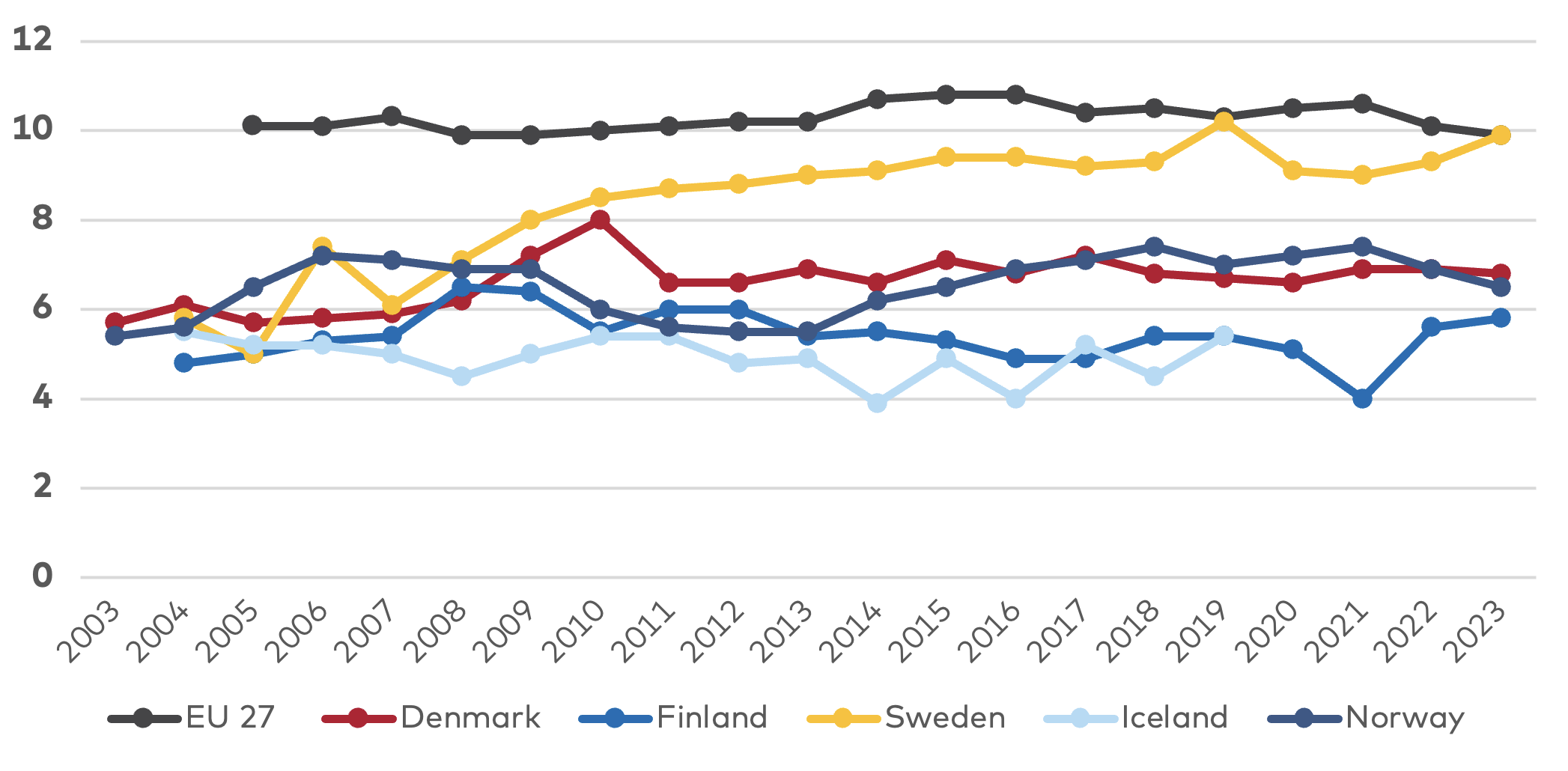
Figure A: Risk of poverty (% of households) by country and time:
50% of median equivalised income
50% of median equivalised income