5. BAVI = BAD + BVD: a conceptual framework
In this conceptual framework the three different levels and aspects that encompass impairment, dysfunction, and deficit in a BAVI context are presented. “Impairment” is referred as the functional loss of a mental process, “dysfunction” as the disruption or failure to function or perform properly during a task or everyday activities, while “deficit” is described as a measurable shortfall or absence of a distinct ability compared to what is expected.
According to the conceptual framework, BAVI as an impairment could be conceptualized as a complex disorder associated with the dysfunctions of both brain based visual processing dysfunction (BVD) and brain based auditory processing dysfunction (BAD). Furthermore, the behavioural manifestations of BVD and BAD are respectively accompanied with visual lower-order & higher-order functional deficits and auditory lower-order & higher-order functional deficits in a coherent way. The conceptual framework illustrates dynamic relationships across the key domains of impairment, dysfunctions and deficits. See figure 3 for the conceptual framework of BAVI.
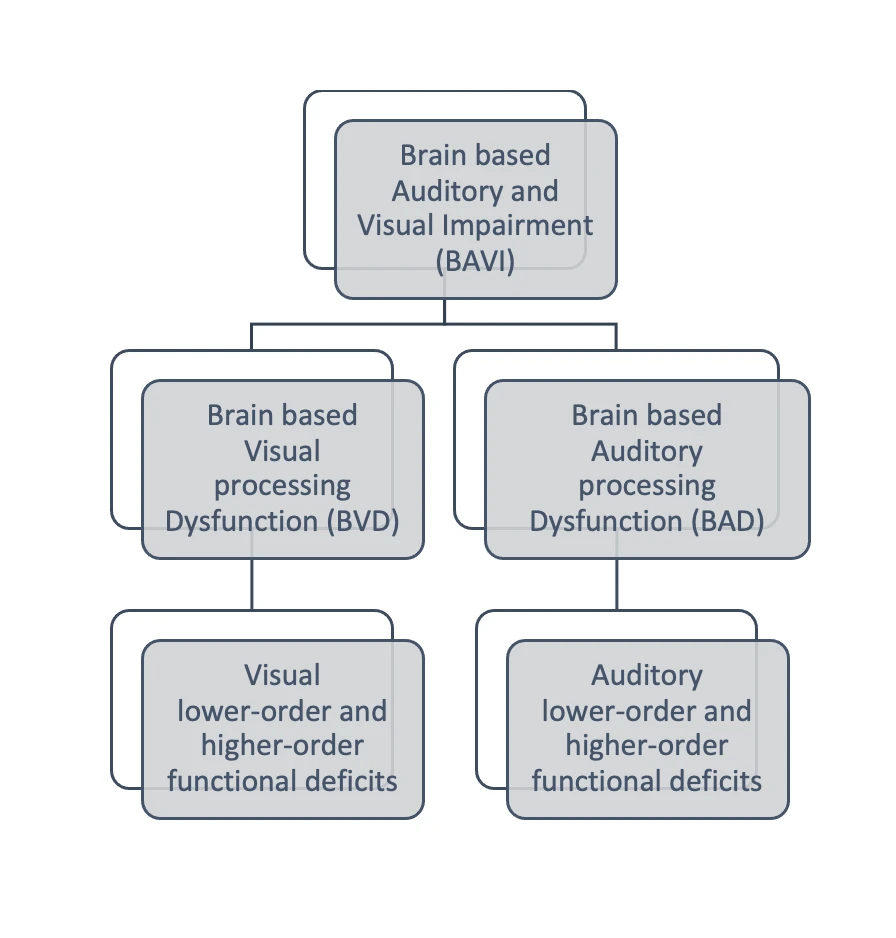
Figure 2: The BAVI conceptual framework: BAVI as an impairment can be conceptualized as a complex disorder associated with the dysfunctions of both brain based visual processing dysfunction (BVD), and brain based auditory processing dysfunction (BAD). Furthermore, behavioural manifestations of BVD and BAD are respectively accompanied with visual lower-order & higher-order functional deficits and lower-order & higher-order functional deficits in a coherent way.