Nordic added value
Nordic added value is key to the institution's areas of operations, and is achieved through close and continuous Nordic dialogue, not least through our networks which consist of 300–350 participants from across the Nordic region. Our networks and expert groups contribute to developing and sharing the knowledge we generate and to existing projects and initiatives for future projects.
The Nordic Welfare Centre's strong Nordic co-operation in the welfare field contributes to increased knowledge, strengthened policy development and better practices in the Nordic countries. The institution's areas of operations and activities are particularly important for achieving the following sub-goals in the Nordic Council of Ministers' co-operation programmes:
Nordic Co-operation Programme for Health and Social Affairs | |
1.1 Welfare provisions in the Nordic Region must be effective, accessible, geographically within reach, safe for both patients are care recipients and based on a preventative and health-promoting perspective that puts the user in the centre. 1.2 Welfare provisions in the Nordic Region must be sufficiently staffed and operated by professionally qualified health and social care personnel. 2.1 Everyone must be offered early, preventative, health-promoting, rehabilitating and relevant measures to reduce health inequality 2.2 Nobody should have to struggle with mental vulnerability or involuntary isolation. 2.3 No-one should be subjected to physical or psychological violence or oppression 3.1 Everyone should have equal opportunities to live good, independent lives. 3.2 All children and young people must have a place in the community and equal opportunities to grow up with security, stability and good future prospects 3.3: Everyone must have the opportunity to participate in meaningful and constructive communities |  |
Nordic Co-operation Programme for Labour | |
2.1: Develop more knowledge on how to get more people into employment or training, with a special focus on groups on the margins of the labour market, such as senior citizens, persons with disabilities, women of non-European descent and young people who are neither in work nor in unemployment. 2.2: Improve the levels of equal treatment and equality on the labour market in order to enable the Nordic Region to mobilise the full range of skills in the labour force, regardless of gender, gender identity or expression, ethnicity, religion or other beliefs, disability, sexual orientation or age. |  |
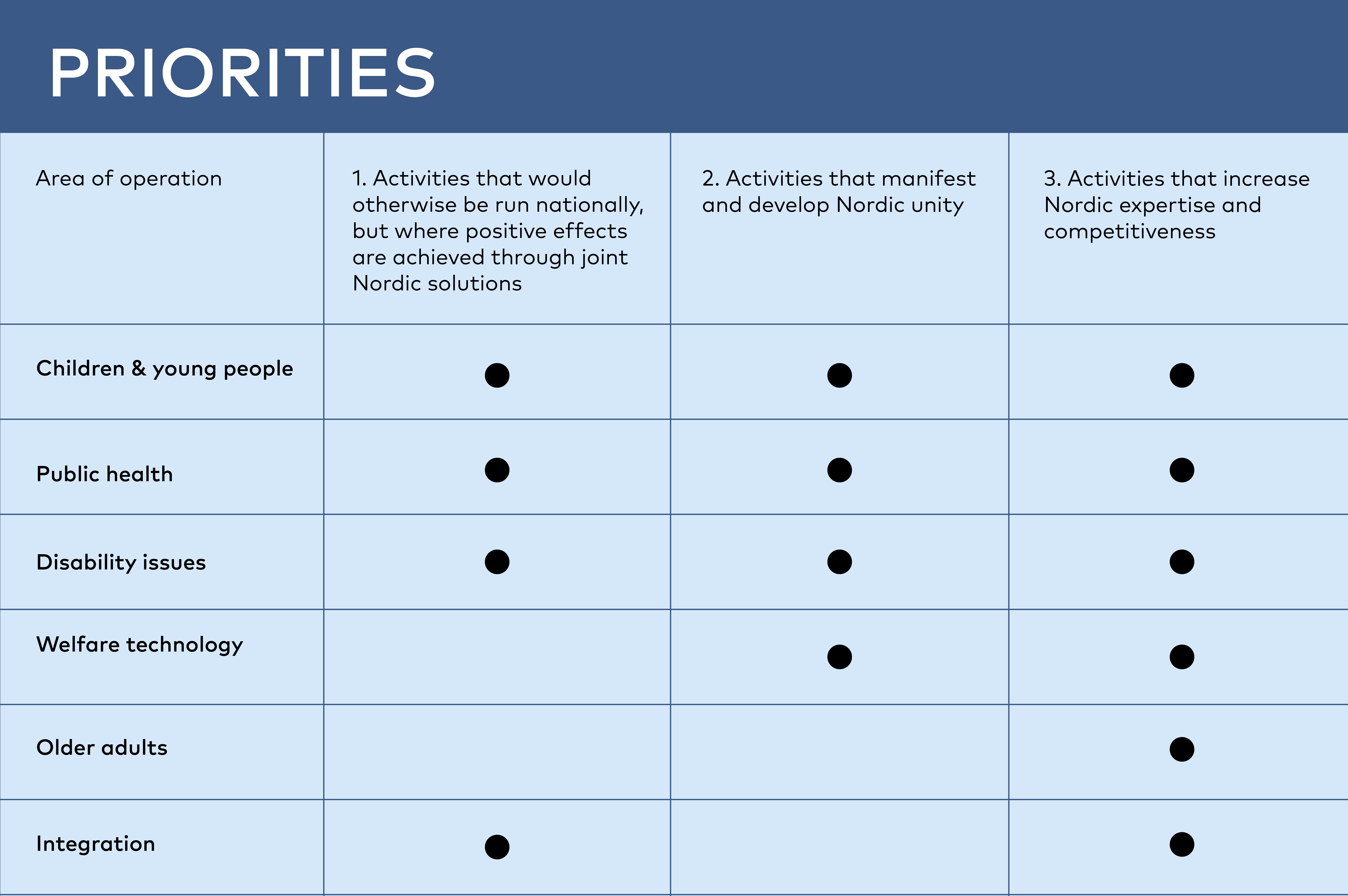
Regarding the criteria for Nordic added value set up by the Nordic Council of Ministers, several of the areas of operations have projects and activities that meet all the priorities, and the institution is considered to contribute to Nordic added values in all areas:
PRIORITIES | |||
Area of operation | 1. Activities that would otherwise be run nationally, but where positive effects are achieved through joint Nordic solutions | 2. Activities that manifest and develop Nordic unity | 3. Activities that increase Nordic expertise and competitiveness |
Children & young people | ● | ● | ● |
Public health | ● | ● | ● |
Disability issues | ● | ● | ● |
Welfare technology | | ● | ● |
Older adults | | | ● |
Integration | ● | | ● |
Below are a few examples from each area of operations.
Children and young people
Regulation of children's and young people's use of digital media is being debated in many countries. The Nordic countries are exchanging experiences in this area and drawing inspiration from each other's guidelines, regulations, initiatives and solutions. Nordic and international co-operation is key, and Nordic co-operation in this area gives the countries a stronger voice in dialogue with the EU and multinational companies.
Public health
The Nordic added value of Nordic co-operation in public health is particularly evident in the context of the increasing burden of non-communicable diseases and an ageing population. There is great potential for improving health and increasing healthy life years in the Nordic region.
Disability issues
The co-operation on disability issues helps to rationalise and support the implementation of the UNCRPD at national level. The co-operation strengthens the Nordic community and Nordic values by placing the Nordic region in an international context. Activities in the deafblind field in particular contribute to an increased knowledge base, as the population in each individual country is too small to develop its own knowledge.
Welfare technology
The focus of the activities is on collaboration, mapping and knowledge compilation regarding the implementation of welfare technology. Through these activities, the countries are supported in meeting demographic challenges at national and Nordic level. Skills development and competitiveness are manifested in joint projects and Nordic networks, not least in the field of research.
Older adults
The work to develop sustainable cities and communities contributes to more resilient and socialy sustainable societies. The activities contribute to increased competence in sustainable community development in the Nordic region, and knowledge sharing contributes to policy development that both promotes functional health and prevents chronic diseases.
Integration
Nordic co-operation on integration of refugees and immigrants generates Nordic benefits through knowledge development and the exchange of experience, primarily in the areas of education and the labour market.